


Two Pets, One Portrait: How Multi-Pet Portraits Work
Got two pets and can't choose? Multi-pet portraits capture both animals in one frame — here's how the process works, from photos to final print.
Two Pets, One Portrait: How Multi-Pet Portraits Work
Something changes when you have two pets. A dog and a cat who have negotiated their truce over years of shared couch space. Two dogs who have been inseparable since the day the younger one arrived. A pair of cats who sleep in the same patch of afternoon sunlight every single day. The bond between them is half the story, and a portrait of either one alone feels like it's missing something.
Multi-pet portraits are one of the most requested things we do at MaginePaw, and also the ones that generate the most questions before people order. How do you capture two different faces accurately? Do the pets need to appear in the same photo together? What happens if one is dramatically bigger than the other? Here's how it actually works.
You don't need a photo of them together
This is the most important thing to know upfront. You can absolutely submit separate photos of each pet, and in many cases that produces a better result than a joint photo would. Getting two animals to hold still and look camera-forward at the same time is nearly impossible, and a blurry group shot means at least one pet's face ends up compromised.
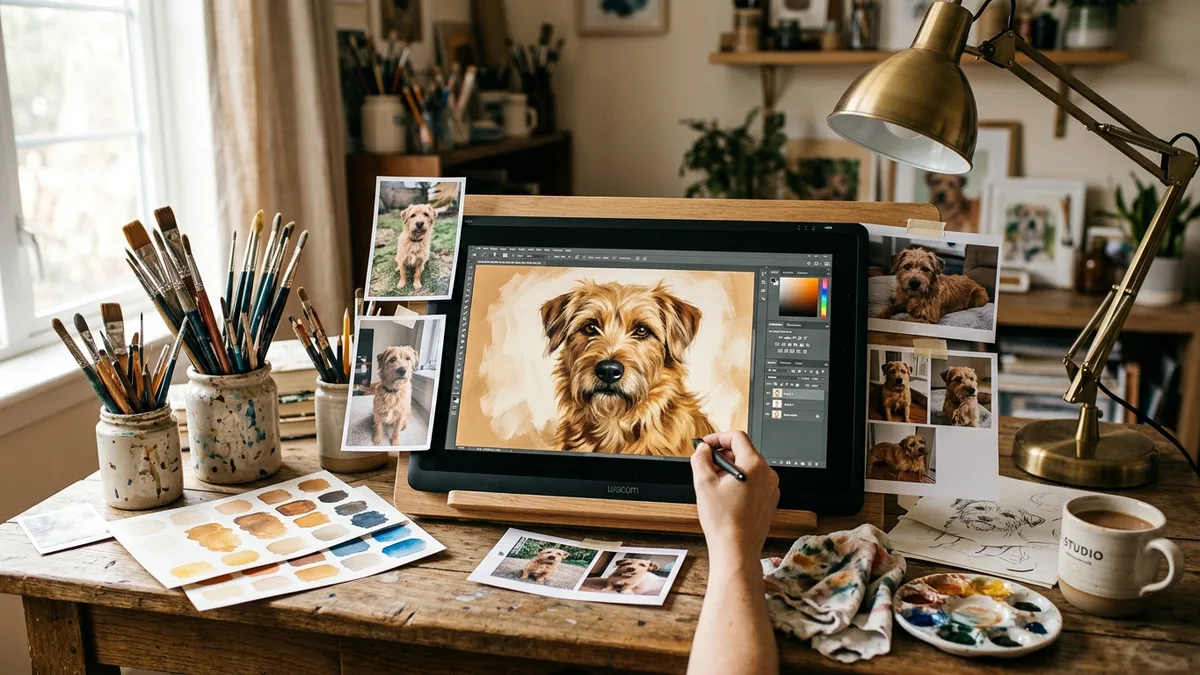
What our process does instead is use the best individual reference photo of each animal — one clear, well-lit close-up per pet — and compose them together in the final portrait. The positioning, sizing, and how their relationship reads in the frame is handled by the artist. That's actually where a lot of the craft lives: making two separately-photographed animals feel like they genuinely belong in the same scene, not like a cut-and-paste job.
If you do happen to have a good photo of them together — napping side by side, both facing the camera at the right moment — use it. But don't stress if you don't. Separate photos of each at their clearest will usually get you further.
What makes a good reference photo for each pet
The photo guidelines are the same as for single portraits, just applied twice. For each animal, you want natural light, an eye-level angle, and the face fully visible without anything cutting across it. Eyes need to be in sharp focus — that's where likeness lives, and a soft eye in the reference means a soft eye in the portrait.
Avoid shots where the animal is looking away, ears are pinned back from anxiety, or a hand or lead is partially blocking the face. If you have ten decent photos and one genuinely great one, use the great one. The portrait is only as accurate as the reference you provide, and this is doubly true when there are two subjects to get right.
For coat markings, the more distinctive the pattern — a brindle dog, a tortoiseshell cat, a pet with asymmetric markings — the more a sharp, close reference matters. Generic reference produces generic results; specific reference produces a portrait that actually looks like your animals.
How the likeness review handles two subjects
Every MaginePaw portrait goes through six takes with an automated likeness check before it reaches you. For multi-pet portraits, both animals go through that process independently. The system evaluates coat pattern, face shape, eye color, and key markings for each pet, and flags takes where either animal has drifted from the reference.
This matters because it's easy for a portrait to nail one pet and let the other become slightly generic. The review is specifically designed to catch that. If your golden retriever comes through perfectly but the tabby looks like any orange cat rather than your specific tabby, that gets flagged and corrected before you ever see the result.
If you want to see which styles have worked best for multi-pet commissions, the full range is at /styles. Painterly and illustrated styles tend to give both animals compositional room to breathe. Detailed realism can be extraordinary, but it requires excellent reference photos for both pets without exception — the style has nowhere to hide.
Sizing and composition in the frame
What if your pets are very different in size? A Chihuahua next to a Bernese Mountain Dog, or a kitten sharing the frame with a very large Maine Coon?
Composition is handled thoughtfully, not mechanically. The proportional relationship between them stays natural — if one animal is genuinely much larger than the other, that reads in the portrait. What gets adjusted is framing and closeness: a tighter crop can bring two differently-sized animals into the same visual space without the smaller one disappearing.
If you have a preference for positioning — one slightly in front, side by side, one turned toward the other — add it to the notes when you submit. These are read and passed to the artist, and they make a real difference in the final composition.
The free preview, and what to look for
Before any physical print is ordered, you get a free watermarked preview of your portrait. For multi-pet orders this is especially worth examining carefully. Look at each pet's face separately: does the coloring match? Are the distinctive markings there — the white blaze, the mismatched eyes, the darker muzzle, the one ear that folds differently?
If something is off, the free repaint guarantee covers it. You're not locked into the first result if one of your pets didn't come through the way you hoped. When you request a revision, being specific helps: "the tabby's stripes should be darker and more defined on the forehead" is far more useful than "it doesn't quite look like her." Specific feedback produces specific fixes.
Why two pets in one frame works
A two-pet portrait done well doesn't just show two animals — it shows a relationship. The way they're placed relative to each other, whether they're looking the same direction or one is angled slightly toward the other, the closeness of the composition: these small decisions carry a lot of emotional weight.
People order multi-pet portraits for a lot of reasons. Sometimes it's a gift for someone whose two pets are always together and you can't imagine commissioning only one. Sometimes one pet has passed and the owner wants them depicted alongside the one who's still here — a way of keeping the whole family in the frame. Sometimes it's simply because separating them would feel dishonest to who they actually are.
Whatever the reason, the process is the same: strong reference photos for each animal, clear notes about preferences, a careful likeness review for both subjects, and a preview to check before committing to a print. Digital portraits start at $29; physical formats run from $39 to $219 for larger framed prints. US shipping is free on orders over $75.
Two pets, one frame — and a portrait that finally does justice to both of them.