


How to Photograph a German Shepherd for a Custom Portrait
Sharp, detailed reference photos make all the difference. Here's how to photograph your German Shepherd so a portrait artist can capture the real dog.
How to Photograph a German Shepherd for a Custom Portrait
German Shepherds are remarkable subjects. Those alert, triangular ears, the intelligent gaze, the way the saddle coat transitions from deep black to warm tan — there is genuine visual complexity to work with. But they also operate at full speed most of the time, and that makes getting a great reference photo more involved than pointing your phone and hoping for the best.
If you are planning a custom portrait, the quality of your reference photo is the single biggest factor in how closely the finished piece captures your specific dog. Portrait artists can work beautifully with a good reference, but they cannot invent detail that is not there. Here is how to give them everything they need.
Light is the whole game
German Shepherds have a dense double coat that can look flat and washed-out in poor light, or rich and three-dimensional in good light. Natural light is your best friend, and specifically indirect natural light. An overcast day is genuinely ideal. The soft, diffused light wraps evenly around your dog's face without creating harsh shadows that obscure eye detail or blow out the lighter sections of the coat.
If you are shooting on a sunny day, move your dog into open shade — under a tree, on the shaded side of a building, or in the shadow of a garage overhang. Direct midday sun is the worst option available. It creates deep shadows under the brow that make it nearly impossible to see the eyes clearly, and it flattens the coat texture to almost nothing.
Avoid shooting near windows with direct sun pouring through, and skip your phone's built-in flash. Flash produces a flat, blown-out result that loses all the subtle variation in your dog's coloring — the warm red tones in the tan points, the slight shimmer in a sable coat. A gray overcast sky gives you soft, consistent light you can shoot in all day and the results will be warm and detailed.
Get yourself down on the ground
This is the single most common mistake in pet photography. Shooting from standing height means looking down at your dog, which distorts their proportions and puts the background more in frame than the subject. Sit on the ground, lie in the grass, get to eye level with your German Shepherd. It feels a little ridiculous and it makes a dramatic difference.
Eye-level portraits give the artist an accurate sense of your dog's actual proportions — the depth of the chest, the true set of the ears, the real length of the muzzle. These things look completely different from above versus from the same plane.
For German Shepherds specifically, the ear set is a defining characteristic of the breed. From above, the ears look stubby and close together. From eye level, you see the full, alert, upright profile that makes a German Shepherd instantly recognizable. That is the image worth capturing for a portrait.
The expression you are aiming for
The best portrait reference photos show a dog who is alert and relaxed at the same time — focused and calm, with ears forward. Not the wild-eyed excitement of a dog who spotted something in the bushes, and not the droopy exhaustion of one who just finished a 45-minute run.
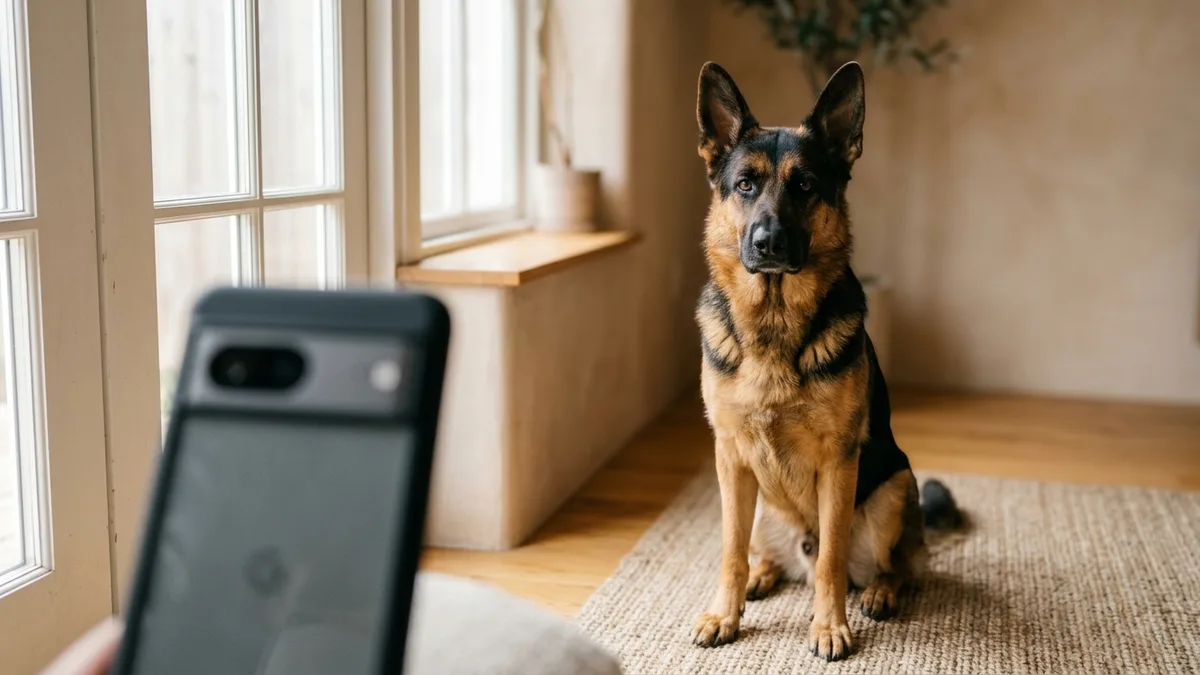
A reliable method for getting that expression: step outside with your dog, let them settle for a minute or two, then make an unexpected sound. A quiet whistle, a word said in a strange voice, a soft squeak from a toy hidden in your pocket. That moment of curious attention — before they figure out what you did — is often exactly the sweet spot. Ears forward, eyes clear, expression interested but not frantic.
You can also try holding a treat or a small toy just above or beside your camera lens. Your dog looks toward it; from the camera's perspective, that reads as direct eye contact. Direct eye contact in a portrait is powerful, and German Shepherds do it exceptionally well.
Avoid photos where the mouth is wide open and panting hard. A soft, relaxed mouth or a gently closed one translates better in a portrait. Panting shots are fine to include as backup references for color and coat detail, but if you can get one calm-mouthed photo, that is your hero image.
Coat detail and how to frame the shot
German Shepherd coats vary more than people realize. Black and tan, sable, all-black, bi-color, white — each presents different photographic challenges. For the classic black and tan, the contrast between the dark saddle and the tan points can be difficult to capture without losing texture in the darker areas.
Shoot in good light and make sure your camera is metering for the dog, not the background. On most phones you can tap on the screen to set the exposure point. Tap on the darker part of your dog's coat. If the saddle is rendering as pure black with no visible texture, try brightening the exposure slightly. You want to see individual hairs and coat variation, not a solid dark shape.
For long-coated German Shepherds, photograph them after a brush-out when the coat is dry and at its fullest. A matted or wet coat gives the artist inaccurate information about your dog's actual appearance, and the portrait will reflect that rather than what your dog looks like on a normal day.
For framing: one shot where the face fills most of the frame, leaving a little room around the ears so no detail is cropped, and one slightly wider shot showing the chest and upper body. That combination gives the artist both the fine facial detail and the broader sense of your dog's build and proportions.
How many photos to take
Take far more photos than you think you need. German Shepherds have fast, expressive faces — the ear twitch between shots, the soft moment right after the alert one, the few seconds of perfect calm before they get distracted. Shoot 30 or 40 frames in a session and sort through them afterward. Delete nothing on the day of the shoot.
When you are ready to submit, it helps to look through /breeds/dog/german-shepherd first to see examples of completed German Shepherd portraits and get a sense of what the artists tend to emphasize in the breed. It is a useful reference for understanding what makes a German Shepherd portrait work.
Once you upload your photos, you get a free watermarked preview before committing to anything. This is your opportunity to confirm the likeness looks right to you. Our repaint guarantee means adjustments are always possible, but the closer your reference photo is to what's described above, the more the first pass will feel like your dog.
One practical note: the German Shepherd who just finished a long walk is not going to give you great portrait photos. Droopy ears, half-closed eyes, open panting mouth — that is a different dog entirely from the one you see when they are fresh and alert. Plan your shoot before exercise, not after. Early morning, before breakfast, with a dog who is awake and motivated by whatever treat lives in your pocket. That is when you get the ears up, the clear eyes, the expression that says this is specifically your dog and not just any German Shepherd. That is the reference photo the artist can build something real from.