


How to Photograph a Poodle for a Custom Portrait
Poodle coats are tricky to capture well. These photo tips help you get a portrait-ready shot at home, on your phone, in any room.
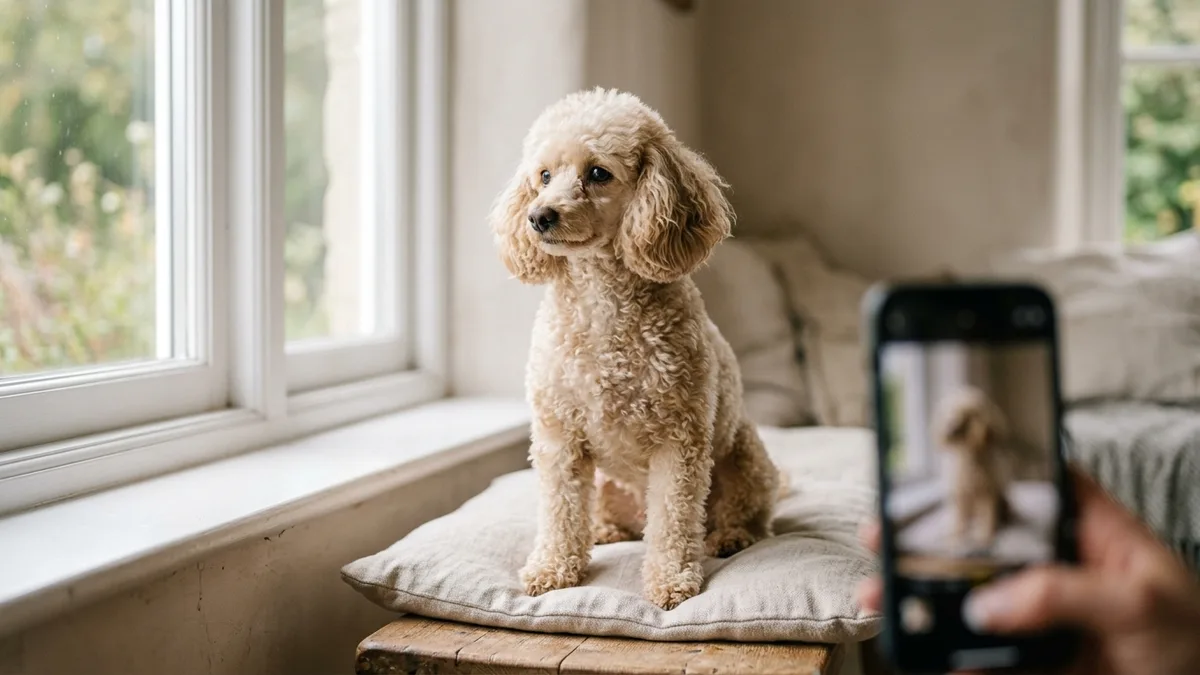
How to Photograph a Poodle for a Custom Portrait
Poodles are gorgeous but notoriously tricky subjects. Whether you have a toy, miniature, or standard, their curly coats catch light differently than short-haired breeds, their dark eyes can vanish into a black coat, and their expressive faces are sometimes half-hidden behind fluffy pompons. Getting a great reference photo means your portrait artist has everything they need to paint those six likeness-reviewed takes with real accuracy.
These tips will help you take portrait-ready shots at home, with nothing but your phone and a little patience.
Lighting is everything for curly coats
Poodle fur has texture and depth that only shows up under good light. The single best thing you can do is photograph near a window with indirect natural light, like a north-facing window or any window where direct sun is not streaming straight through. Overcast days outside are also ideal. Soft, even light wraps around the curls and shows definition instead of flattening them into a single fuzzy mass.
Avoid flash. Flash aimed straight at a poodle washes out the coat's texture and often produces reflective eye shine that makes it hard to see the actual color and shape of the iris. If light is low indoors, open more windows or move your dog closer to the light source rather than reaching for the flash.
Dark-coated poodles, black, brown, or blue, need slightly brighter conditions because the curls can merge into a single dark shape without enough light. White and apricot poodles have the opposite problem: too much direct sun and they blow out to a featureless pale mass. For light-colored dogs, overcast or shaded conditions give the artist far more to work with.
Get down to their level
The most common portrait photo mistake is shooting from above. Aiming down makes the head look oversized and the body disappear, and you end up photographing the top of the muzzle instead of the face. Kneel, sit on the floor, or prop your dog on a couch so the camera sits at eye level.
For toy and miniature poodles this might mean lying on your stomach. It feels ridiculous. The photos come out much better.
A straight front-facing shot and a three-quarter profile, the dog turned slightly so you can see one eye, the nose, and the curve of the skull, are the two angles that serve portrait artists best. If your poodle has a continental or English saddle clip with sculpted pompons, a profile also shows off those shapes clearly.
Think about grooming timing
A fresh groom makes a noticeable difference, but fresh does not have to mean the same day. One to three days after a professional trim is often ideal. The coat is clean and shaped but has had a little time to settle and look natural rather than freshly blown-out stiff.
If your poodle is overdue for a trim, schedule the photo session the day after the grooming appointment. This matters most for teddy bear and puppy cuts, where the coat should be even and well-defined. For dogs with longer, looser curls, a light brush-out before the session helps separate the curls so they show as individual shapes rather than one compressed layer.
Pick a background that does not compete
The background in your photo becomes part of your portrait artist's reference. A busy background, a patterned rug, a cluttered room, outdoor shrubbery, makes it harder to see where your dog ends and the surroundings begin. This is especially true for poodles, where the fluffy coat can blend right into a complex background.
Simple works best. A plain wall, a solid couch, a neutral bedsheet draped behind them. The color should contrast with your dog's coat: a white poodle in front of a white wall is difficult; a white poodle in front of soft gray or green is clear and readable.
Outside works well too, as long as you pick a simple background like a plain fence, open grass, or open sky. Avoid busy tree lines or patterned surfaces directly behind the head.
Getting the expression you want
Poodles are smart and curious, which works in your favor here. Hold a favorite toy or a small treat just above the camera lens to get them looking directly forward. The moment you want is right after you have gotten their attention, when their ears are slightly forward, eyes bright, and they are clearly focused on you.
A helper makes this easier. One person manages the treat or toy; the other takes the photos. That way you are not trying to hold the bait and the camera at the same time.
If you want a calm, dignified portrait, catch them in a quiet moment, right after a walk when they are settled but not drowsy, or during a peaceful rest indoors. Poodles often have a naturally composed expression when relaxed, which translates well into painterly or classical portrait styles. For puppies, shoot after a play session when energy levels drop. Toy poodle puppies in particular move fast, and burst mode helps: take ten shots quickly and pick the sharpest one.
What to send and how many photos
Resolution matters. Submit photos taken at full resolution on your phone, not screenshots or images forwarded through messaging apps, which compress them down. Full resolution lets the artist see the exact shape of your poodle's eyes and the individual curl pattern of the coat.
Send at least three photos: a front-facing shot, a three-quarter profile, and a full body view if you ordered a full body portrait. If your poodle has a distinctive marking, a tan spot above the eye or a patch on the chest, include a close-up of that too. Before you decide on a portrait style, the /breeds/dog/poodle page shows how different coat types and clips look in finished portraits, which is useful for matching your dog's cut to an artistic approach that will suit it.
Once you submit, you will receive a free watermarked preview before anything goes to print, so you can confirm the likeness is right. If something needs adjustment, the repaint guarantee covers another round at no charge.
For poodles with long facial hair falling over the eyes, gently tuck or pin back any fur covering the face before the session. Portrait artists need to see the eyes clearly: the shape, the color, the expression. It is the most important part of any portrait.
If your poodle was recently groomed into a show clip, decide in advance whether you want the portrait to capture that exact style or a more relaxed look. The portrait will reflect whatever you show in your reference photos, so it is worth thinking about before you pick up the camera. The best poodle photo is one where you can clearly see the eyes, the coat has visible texture and definition, and the expression looks like your actual dog on a genuinely good day.