


How to Take the Perfect Photo for an AI Pet Portrait
Simple, real tips for photographing your dog or cat so your AI pet portrait actually looks like them.
How to Take the Perfect Photo for an AI Pet Portrait
The portrait can only be as good as the photo you start with. That's not a scare tactic, it's just how the whole process works. Our artists (and the automated likeness review that checks every piece before it ships) need a clear look at your pet's actual face, in decent light, without a lot of guesswork. Good news: you don't need a fancy camera. You need about five minutes, a treat, and a little patience.
Good light beats good cameras
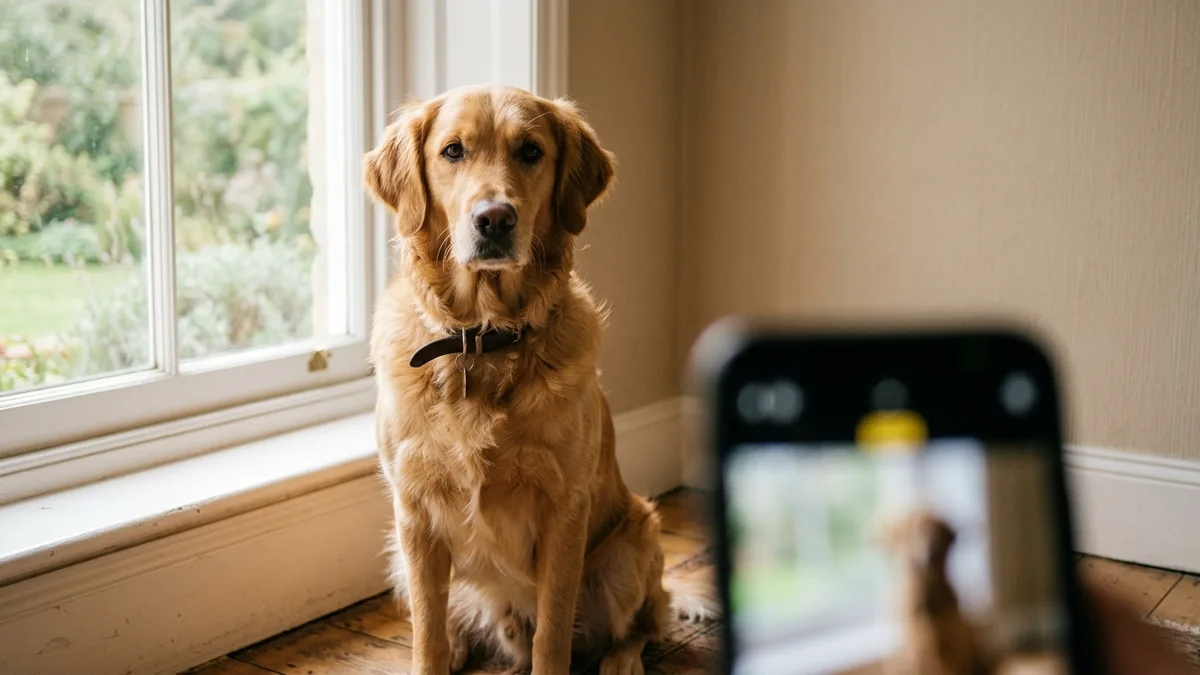
The single biggest difference between a photo that works and one that doesn't is light, not resolution. Standing near a window during the day is almost always your best bet. Overcast days are actually great because the light is soft and even, no harsh shadows cutting across your pet's nose. Avoid flash if you can. It flattens fur texture and turns eyes into two glowing dots, which makes it hard for our artists to capture your pet's real expression.
If you're indoors at night, turn on as many lights as possible and try to angle your pet toward the brightest source in the room. Golden hour outside works beautifully too, especially for lighter-coated pets, though watch that the sun isn't directly behind them or you'll end up with a silhouette instead of a face.
Get down to their level
Most pet photos are taken from above because that's where our hands naturally are. But shooting from up high distorts the proportions, the head looks huge and the body disappears. Get down on the floor, or hold your phone at your pet's eye level. This single change makes photos look about ten times more professional with zero extra effort.
If your dog or cat won't hold still at that angle, try lying down first and letting them come investigate you. Cats especially can't resist a human doing something weird on the floor.
One clear, forward-facing shot matters most
We only need one really good photo to work from, but that photo should show your pet's face straight on or at a slight angle, both eyes visible, nothing blocking their nose or mouth. Profile shots can be striking in real life but they're harder for capturing a full likeness in a painted style. If you've got a photo where your pet is looking slightly off to the side at the camera, that's often the sweet spot, natural but still clear.
Make sure the face fills a good part of the frame. You can always crop in later, but a photo where your pet is a tiny speck in a big landscape doesn't give us much to work with, no matter how gorgeous the scenery is.
Skip the sunglasses, and go easy on the costumes
We love a good pet-in-a-bandana photo as much as anyone, but anything covering the eyes, ears, or mouth makes it harder to translate your pet's real features into a portrait. Save the costume shots for your camera roll and choose a plain-faced photo for us. Collars, harnesses, and favorite bandanas are all totally fine since they don't obscure the face.
If your pet has long fur that naturally covers their eyes, a photo where you can still see at least the shape and color of their eyes will help a lot. A quick brush beforehand does wonders.
Background clutter is fine, but simpler helps
Honestly, the background barely matters for the final portrait since our styles replace it entirely, whether you're going for something like a Renaissance oil look or a cozy cartoon theme. But a busy background can make it harder to tell where your pet ends and the couch cushions begin, especially with pets who blend into their surroundings (looking at you, gray cats on gray couches). A plain wall, a bed, or the floor all work well.
Multiple photos help more than one perfect one
If you've got a few decent shots, send more than one. Sometimes a slightly blurry photo has the perfect ear position, while a sharp one has the eyes just right. Our artists work through six takes on every single portrait, refining details with each pass, so having a couple of reference angles gives them more to work with if your pet has any distinctive markings, like a heart-shaped nose spot or a white patch that curls a particular way.
This is especially useful for pets with unusual coloring or breed mixes where one photo alone might not capture how their coat actually looks in different light. If you're not sure what to expect from your particular pet's coloring or breed traits, our breed pages like /breeds/dog/golden-retriever walk through common markings and coat patterns that tend to photograph well.
What to do if you only have older or lower-quality photos
We get a lot of questions from people working with a beloved photo of a pet who has since passed, and totally understand that you can't always go take a new one. Older photos, phone screenshots, even printed photos you've rescanned can all work, especially if the face is visible and reasonably in focus. Zoom in on your phone before you decide it's too blurry. Sometimes what looks soft on a big screen is perfectly usable once resized. If you're working from a memorial photo, our memorial guide has more specific tips for choosing the right one.
How to check your photo before you upload it
Before you submit anything, take thirty seconds to actually look at the photo the way a stranger would. Can you tell what color their eyes are? Can you see the shape of their ears? Would you recognize this specific pet, not just any pet of their breed, from this photo alone? If yes to all three, you're in great shape.
And if you're still not sure, upload it anyway. Every order starts with a free watermarked preview, so you'll see exactly how your pet's likeness comes through in your chosen style before you commit to a print or spend a cent. If something looks off, whether the ears are a little too pointy or the coloring feels slightly wrong, we offer a free repaint guarantee, so it gets fixed rather than shipped as-is.
One last thing worth saying: the perfect photo doesn't have to be a professional one. Some of our favorite portraits have come from slightly goofy phone snapshots taken mid-zoomie or right after a bath. What matters most is that the face is clear, the light is decent, and the moment feels like your pet. Browse a few of our styles at /styles if you want a sense of which looks tend to pair well with which kind of photo, playful poses do great with our cartoon styles, while a calmer, front-facing shot tends to shine in the oil painting and classical portrait styles. Either way, a little effort with the camera now saves a lot of back and forth later, and gets you a portrait that actually looks like your pet, not just a pet.