


How to Photograph a Siamese Cat for a Custom Portrait
Siamese cats are all contrast — pale coat, dark points, sapphire-blue eyes. Here's how to photograph yours so a custom AI portrait captures every bit of it.
How to Photograph a Siamese Cat for a Custom Portrait
Siamese cats are built on contrast: a pale, fine, close-lying coat against dark seal, blue, chocolate, or lilac points on the ears, face, legs, and tail, with a pair of sapphire-blue eyes doing most of the talking. That contrast is what makes the breed instantly recognizable — and it's also exactly what a phone camera tends to get wrong. Blow out the light a little and the body disappears into white. Underexpose to protect the points and the pale coat goes gray and flat. Getting a photo that holds onto both ends of that contrast takes a slightly different approach than photographing a solid-colored cat.
Here's how to get a reference photo that does the breed justice.
Light for contrast, not just brightness
The core challenge with a Siamese is dynamic range: the coat and the points sit at opposite ends of the exposure scale, and most cameras want to average them into something in between. Direct flash and harsh overhead light make this worse — they flatten everything and tend to blow out the pale body while crushing detail into the dark points.
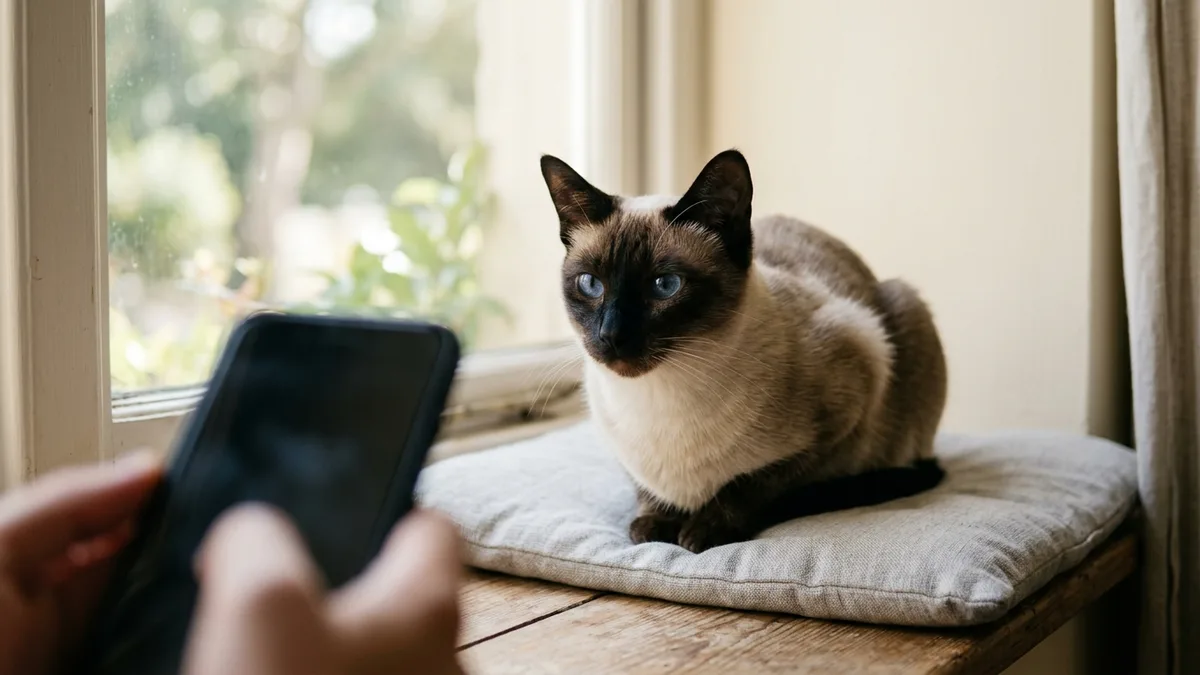
Soft, diffused daylight is the fix. A spot near a window, out of direct sun, gives you even light that shows texture in the pale coat while still holding onto shading in the seal or blue points, instead of a solid block of dark. Overcast days and shaded outdoor spots work for the same reason. If you're shooting somewhere the light is more direct, angle your cat so the light falls across them rather than straight into the lens, and check your phone's preview for any part of the frame that's gone pure white or pure black — that's detail you won't get back later.
Get the eyes tack sharp
A Siamese's eyes are the feature people notice first, and they need to be the sharpest thing in the frame. Tap to focus directly on the eyes rather than letting your phone default to whatever's nearest the lens, which is often a nose or a paw. Almond-shaped and vividly blue, Siamese eyes photograph best with a catchlight — a small reflected highlight from a window or light source — which is what makes them look alert and alive in a photo instead of flat.
If the rest of the face is a touch soft from depth of field, that's forgivable. Blurry eyes are not — they're where a portrait artist starts when building a likeness, and soft detail there is very hard to recover later.
Keep the background plain
Because the appeal of a Siamese is the pattern itself — the clean break between coat and points — a busy background competes with it. A plain wall, a neutral blanket, or a windowsill without much clutter behind it keeps the eye on the cat instead of splitting attention with a patterned rug or a bookshelf. This matters more for Siamese than for most breeds, since their coloring already reads as high-contrast; adding visual noise behind them just makes the pattern harder to isolate.
Let their personality come through
Siamese cats are famously vocal, social, and people-oriented — they tend to follow you room to room and have opinions about most things. That personality is worth capturing, not just the coat. A candid shot mid-meow, ears forward and alert, or a cat perched somewhere elevated and watching you with obvious interest, often reads truer than a posed, sitting-still shot. A feather wand or a piece of string held just above and behind the camera lens is a reliable way to get a direct, engaged look without the flattened ears of a startled cat.
A few technical basics
Send three to five photos rather than hunting for one perfect shot — a straight-on, a slight three-quarter angle, and at least one candid, alert pose. Get down to your cat's eye level rather than shooting from standing height, since a top-down angle compresses the face and makes the points harder to read accurately. And check each shot for motion blur around the ears and tail before moving on — Siamese are quick, and a soft edge there is common.
Why the photo matters for your portrait
Whatever photo you upload is what your AI portrait is actually painted from, across any of our 12 art styles — so a photo that holds onto both the pale coat and the dark points gives the artist real detail to work with instead of guessing at it. Once you've got a shot you're happy with, the free watermarked preview is the fastest way to check it worked before you commit to anything: you'll see exactly how the portrait reads before you pay, and if the likeness or the points don't come through the way you expected, it's covered by a free repaint.
Digital files start at $29; if you want something for the wall, prints start at $39, with framed canvas from $89. On the Siamese breed page, a few styles are called out as a particularly good fit for the breed's coat and coloring, though all twelve remain open to try.
Get the light even, the eyes sharp, and the background out of the way, and you'll have a reference photo that does justice to one of the most recognizable coats in the cat world. Start your Siamese portrait whenever you're ready.