


How to Photograph a Golden Retriever for a Custom Portrait
Great reference photos make better portraits. Here's how to photograph your golden so every detail — fur, eyes, expression — comes through clearly.
How to Photograph a Golden Retriever for a Custom Portrait
Golden retrievers are made for portraits. That thick, honey-colored coat. Those dark, expressive eyes. The way they look directly at you like they're about to say something important. But translating all of that onto canvas or paper depends almost entirely on the reference photo you start with.
A blurry phone snap taken mid-run in harsh midday sun gives the artist very little to work with. A sharp, well-lit close-up taken during your dog's calmest twenty minutes of the day? That's where the magic happens.
Here's what to aim for.
The golden hour is doubly good for goldens
Golden retrievers have a complication that most other breeds don't: their fur is nearly the same color as warm sunlight. Shoot them in direct afternoon sun and the whole coat blows out into one undifferentiated pale blob, with none of the depth or layering that makes golden fur so beautiful.
The solution is to shoot in soft, indirect light. Early morning or late afternoon works perfectly because the light is warm but diffused. Overcast days are quietly excellent too. The clouds act as a giant softbox, wrapping your dog in even light that shows every individual strand of fur without harsh shadows or blown-out highlights.
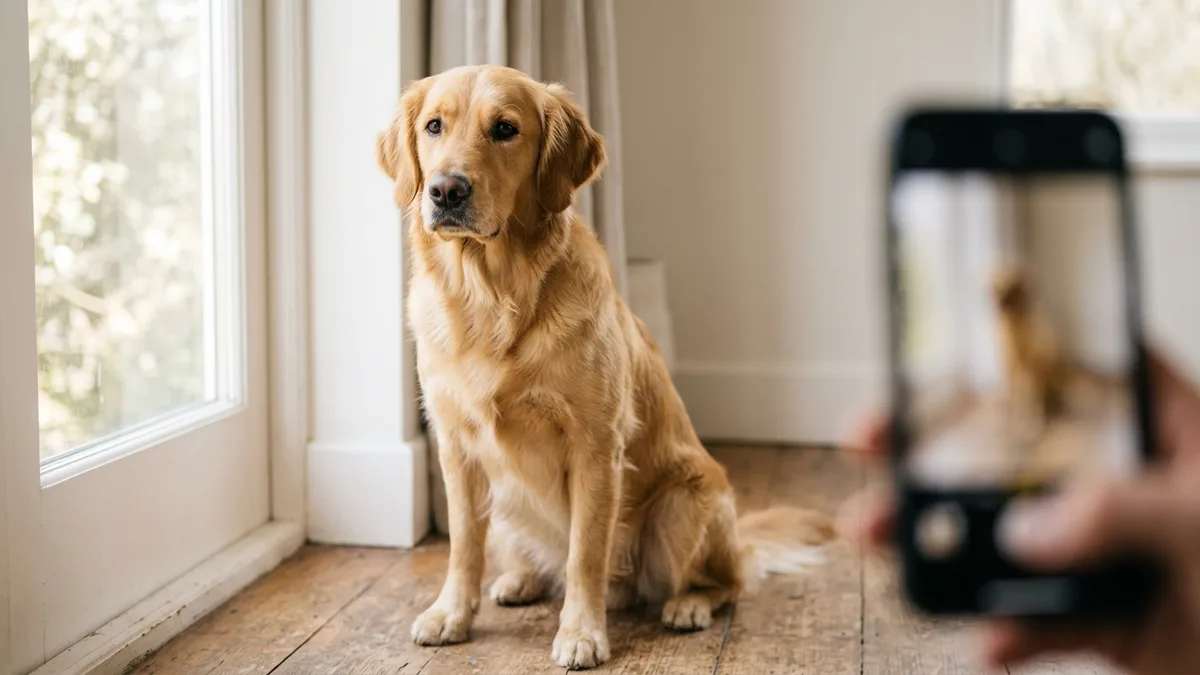
Inside, sit near a large window with no direct sun beam hitting your dog. Position them so the window light falls on their face at a slight angle. This creates just enough shadow to give their features dimension without making everything look flat.
Avoid midday sun, bright flash, and any situation where the background is lighter than your dog. That last one tricks automatic exposure systems into underexposing the subject, which costs you fur detail.
Get on their level
Portraits taken from standing height make dogs look small and distorted. Get down. Lie on the floor if you have to. You want the camera at roughly eye level with your dog, somewhere between six inches and two feet off the ground depending on whether you have one of those big, low-slung show goldens or a bouncier younger one.
Eye-level shots make the eyes the focal point, and that matters. Golden retrievers have deep brown eyes with a warmth that's one of the defining things about the breed. A portrait painted from a top-down angle loses most of that. When the eyes are level with the lens, they come through clearly, and that's what makes people stop and look at a finished portrait.
For reference photos, aim for the face and chest to fill about two-thirds of the frame. You don't need full-body shots. In fact, zooming in a little gives the painter more detail to work with. If you're looking at portrait options on /breeds/dog/golden-retriever, you'll notice the most striking results all show the face close and clear.
How to get them to actually look at the camera
This is the hard part. Golden retrievers are social, enthusiastic, and almost pathologically interested in everything around them, which means getting them to hold a calm, direct gaze for the fraction of a second you need can be genuinely tricky.
Hold a treat at the camera. Don't wave it around — just hold it still against the lens. Your dog will fixate on the treat, and the resulting photo will look like they're making direct eye contact. This works especially well for that alert, ears-slightly-forward expression that reads so well in a portrait.
A weird sound they've never heard works well too. A gentle whistle, a mouth pop, or a short recording of a bird will make them freeze and look directly at the source for a second or two. That's your window.
Tire them out first. A dog that's just come in from a thirty-minute walk is calmer and more settled. Some of the best portrait reference photos happen in that mellow ten minutes right after exercise.
What you're looking for in the expression is relaxed and present. A slightly open mouth is fine. Many people love a portrait where their dog looks like they're smiling. Ears should be natural, not pinned back, and eyes should be fully open and clear.
Watch out for these three photo killers
Red-eye comes from shooting with flash in low light. It makes brown eyes look orange or red and loses all the depth and detail in the iris. If you need more light, add a lamp to the room rather than using the camera flash.
Closed or squinting eyes come from shooting in bright sun. When a dog is looking toward a strong light source, they squint naturally. The photo looks sleepy or uncomfortable, and the artist has nothing to work with. Shoot with the light coming from behind or beside the camera, never pointed directly at your dog's face.
Blur is the third killer. Goldens are wiggly. They shake their heads, they pant, they suddenly decide to investigate something six inches to the left. Shoot in burst mode if your phone has it, and take twenty photos for every one you actually intend to use. You'll get one that's sharp when the others aren't.
The technical details that make a difference
Focus on the eyes, not the nose. Most cameras want to focus on whatever is closest to the lens, which is usually the nose. Tap the eyes on your phone screen to lock focus there before you press the shutter.
Don't crop too tight. Leave some space around your dog. The portrait artist needs to see where the fur ends, what the neck looks like, how the ears fall. A photo where the ears are cut off is harder to work with than one that's slightly wider.
Natural backgrounds work better than busy ones. A green lawn, a wooden fence, or a neutral wall are all fine. A patterned rug or anything with strong contrast behind your dog can distract from the subject and affect the likeness.
Send multiple photos instead of hunting for one perfect shot. Three to five images from different angles gives the artist a full picture of your dog's face shape, how their fur lays, and what their best angle is. A three-quarter view, a straight-on, one slightly from the side.
Try the free preview first
Before committing to a full portrait, upload your best photo and use the free watermarked preview to see how your golden actually looks in the style you're considering. It's the fastest way to check whether your photo has enough detail and light to produce a good likeness. If the preview looks a little flat or generic, it's almost always a lighting issue in the source photo. Try another shot near a window, and you'll usually see an immediate difference.
Golden retrievers are among the most-painted breeds on the platform, and for good reason. Their expressiveness translates beautifully across styles, from classic oil portrait to watercolor to bold pop art. The photos that produce the best results all share the same qualities: sharp eyes, soft natural light, a relaxed expression, and enough fur detail that the texture comes through.
Take ten minutes on a calm morning with good window light, and you'll have a reference photo worth painting.