


Why the End of Summer Is Hard on Your Dog Too
When the kids go back to school, dogs and cats feel the quiet too. Here's why the shift is hard on them, and how to make it easier.
Why the End of Summer Is Hard on Your Dog Too
The Summer Your Dog Got Used To
For ten or eleven weeks, your dog had company almost around the clock. Kids underfoot at 9am instead of racing out the door. Someone to lie next to during a lazy afternoon. A extra set of hands for treats, an extra lap for naps, an extra set of footsteps that meant something interesting was about to happen.
Dogs do not experience that as a nice bonus. They experience it as the new normal. And when the new normal is suddenly reversed, in the space of a single Monday morning, they notice.
Why the Back-to-School Shift Hits Differently
A parent going back to an office after a vacation is a familiar disruption to a dog. It happens for a day, maybe a week, and the household finds a rhythm. Back-to-school is different because it usually stacks several changes on top of each other at once: an earlier, more rushed morning, a much quieter house for many more hours, and often the loss of the one or two family members a dog was most attached to that summer.
Cats feel a version of this too, even if it shows up more subtly. A cat who spent the summer supervising homework from the back of the couch may simply seem more clingy, more vocal, or oddly present the moment anyone finally comes home.
What Separation Anxiety Actually Looks Like
Not every dog who misses the kids has separation anxiety in the clinical sense, but the everyday signs overlap and are worth knowing:
- Pacing, whining, or barking in the first 20 to 30 minutes after everyone leaves - Chewing, scratching at doors, or other destructive behavior that is new or worse than before - Accidents in the house from a dog who is normally reliably house-trained - Excessive drooling or panting when there is no heat or exercise to explain it - An overly dramatic, almost frantic greeting when the family returns
A little restlessness for the first few days of a new routine is normal and usually settles on its own. Behavior that is intense, escalating, or still happening after two or three weeks is worth paying closer attention to.
How to Make the Transition Easier
Practice the goodbye before it counts. In the last week of summer, run a few short dry-run absences: leave for 10 or 15 minutes at the same time the house will actually empty out once school starts. It gives your dog a chance to learn that the door closing does not mean the day is ruined.
Keep the goodbye boring. A long, emotional send-off can teach a dog that departures are a big event worth being anxious about. A calm, low-key goodbye, said a few minutes before anyone actually leaves, tends to land better.
Give them a job for the empty hours. A stuffed puzzle toy, a frozen treat, or a slow feeder timed to when the house empties out gives a dog something to focus on besides the silence. Mental effort tires a dog out in a way that idle waiting never does.
Leave something that smells like the family. A worn t-shirt or a blanket from a kid's room in the dog's bed can take the edge off a suddenly quiet house.
Build in a midday break for the first week or two. A short walk from a neighbor, a dog walker, or even a quick lunchtime visit from a parent can turn one long, lonely stretch into two more manageable ones while everyone adjusts.
When to Talk to a Vet or Trainer
If the signs above are severe from day one, if your dog injures itself trying to escape a crate or a room, or if the anxious behavior has not eased after a few weeks of a consistent routine, it is worth a conversation with your veterinarian. True separation anxiety is a well-recognized and treatable condition, and a vet can rule out other causes or refer you to a certified trainer or veterinary behaviorist for a structured plan.
A Small Way to Hold Onto the Summer
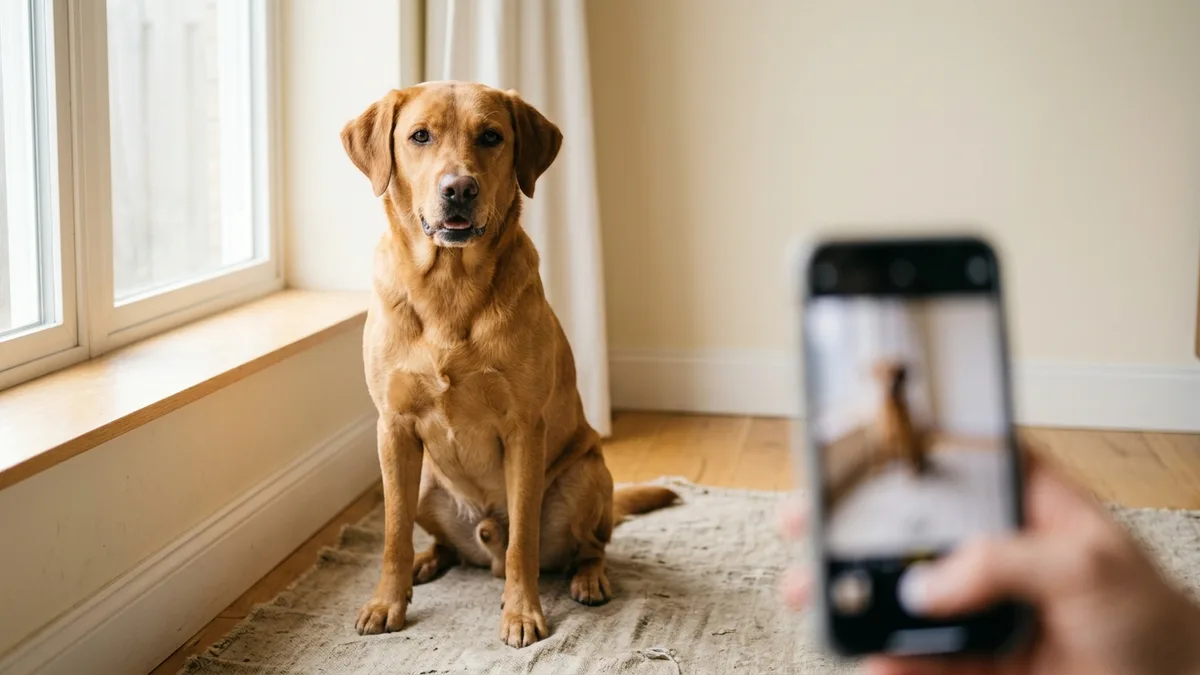
There is something a little bittersweet about this time of year for pet owners too. The long, unstructured days with the dog stretched out in a patch of sun while the kids ran in and out are already turning into a memory. A handful of families mark that shift by turning a favorite photo from the last weeks of summer, the dog mid-chase in the backyard, or curled up with a kid on the couch, into a custom portrait that stays on the wall long after the routine settles back into its school-year shape.
It will not fix a case of the Monday-morning blues for your dog. But it is a nice reminder, for you, of exactly what they are missing.
Commission their portrait tonight. It takes two minutes to start, and their spot on the wall is waiting.