


How to Photograph a Bengal Cat for a Custom Portrait
Bengals are gorgeous and nearly impossible to keep still. Here's how to get the sharp, expressive shots that make a portrait actually look like your cat.
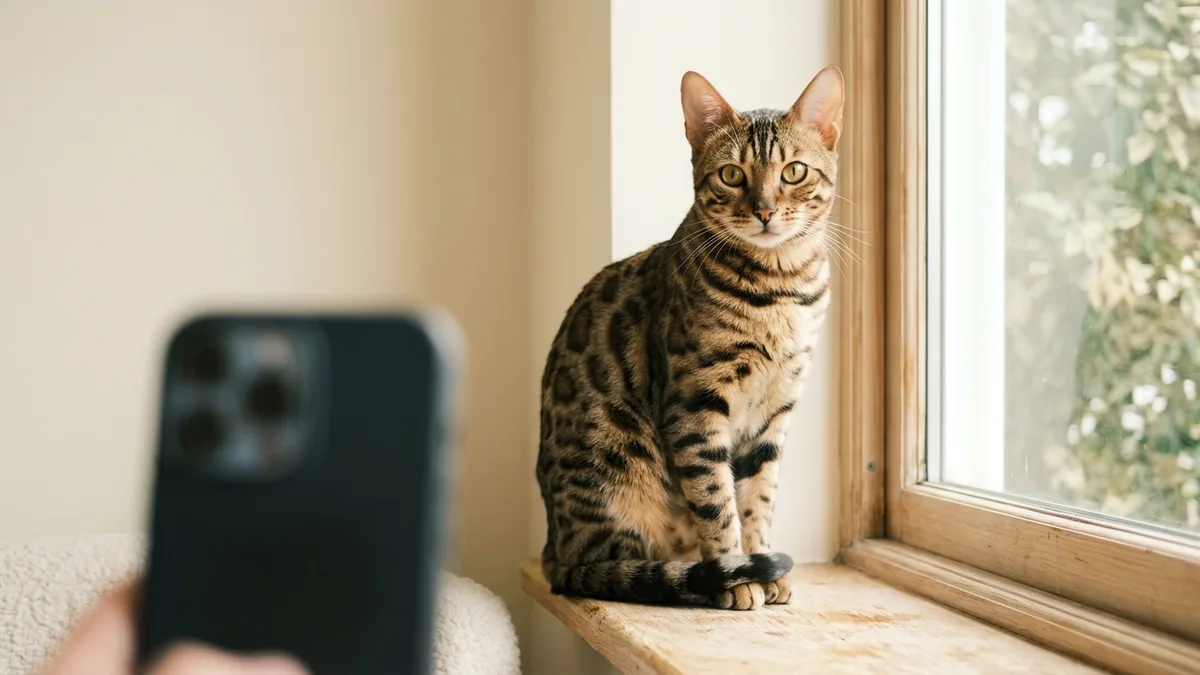
How to Photograph a Bengal Cat for a Custom Portrait
Bengal cats are possibly the most visually striking domestic cats alive — and, as anyone who has tried to photograph one can confirm, the most infuriating subjects on earth. They move like they're late for something, their eyes catch every flicker of light, and the second you raise your phone they decide the camera needs thorough investigation instead.
Good news: you don't need studio gear or a photography background. You need patience, a little strategy, and a handful of tricks that work specifically for a cat bred to look like a small leopard.
Know your Bengal's coat before you start
Bengal cats come in two main pattern types — spotted (including rosettes, the two-toned spots that most resemble a leopard's coat) and marble (flowing swirls that look almost painted on). Before you pick up the camera, decide what you want the portrait to emphasize. Spotted coats look remarkable when light hits at an angle and creates depth in each rosette. Marble coats often photograph best in soft, even light that lets the contrast between dark and light swirls come through clearly. Some Bengals also carry the glitter gene, which makes their fur shimmer in direct sunlight — worth experimenting with if yours does.
Knowing what you're working with helps you build the right conditions instead of hoping something lands.
Timing matters more than equipment
Bengals run on high-energy cycles with specific rest windows. You are not going to capture a usable portrait shot while they're in active mode — they'll be a blur, or they'll be chewing the camera strap. The golden window is immediately after a vigorous play session or a big meal. Fifteen to twenty minutes after your Bengal has sprinted the hallway six times and eaten, you'll have a cat that is alert but willing to stay put. Alert eyes, relaxed body, not actively looking for things to knock over — that's your moment.
If your cat returns to a favorite perch regularly, set up near it. Familiar territory means they're less likely to relocate the second you pull out your phone.
Get the light working for you
Natural light is almost always better for Bengals than artificial. Flash photography does two things you don't want: it flattens the coat pattern and triggers the dreaded eye-shine, turning those gorgeous gold or green eyes into glowing orbs.
Position your Bengal near a large window on an overcast day, or during soft morning or late afternoon light. Harsh midday sun is too directional — it blows out highlights on that sleek coat. A white wall opposite the window acts as a natural reflector and fills in shadows without any equipment at all.
If you're shooting indoors at night, use a lamp with a warm bulb placed to the side of the cat rather than directly in front. Side-lighting pulls out the texture and depth of the coat pattern in a way that flat overhead light simply won't.
Getting sharp shots of a fast cat
Use burst mode. This is non-negotiable with an active Bengal. Hold down the shutter and take ten frames at once, then review. You'll discard nine and keep one sharp, expressive shot — but that one frame is worth it.
Keep your camera braced against something. A lot of Bengal portrait blur comes from camera shake, not cat movement, especially in lower light. Lean your elbow on a table or prop your wrist against the floor to stabilize.
Shoot from the cat's eye level, not from above. A photo taken looking down at a Bengal diminishes them — they become a cat-shaped blob instead of a powerful, athletic animal. Get low. Lie on the floor if you have to. The perspective shift is dramatic and immediately noticeable in a finished portrait.
Where to focus on the face
Every great pet portrait hinges on the eyes. When in doubt, focus on the eye closest to you and let depth of field take care of the rest. A Bengal's eyes — whether jade green, amber, or the sought-after gold — carry an intensity that photographs beautifully when they're tack-sharp.
Aim for a three-quarter face angle rather than straight-on. The 3/4 angle gives the portrait dimension, shows the cheekbone structure and whisker length, and lets you see the coat pattern as it wraps around the face. Straight-on can look flat; a full profile loses the eyes. Most of the best pet portraits land somewhere in that 3/4 zone.
If your Bengal has strong facial markings — the mascara lines that run from the inner corner of the eye, or vivid whisker spots — position the light so those features read clearly without blowing out the surrounding fur detail.
Choosing a background
Bengals are visually busy cats. Their coats demand a background that doesn't compete. A plain wall, a neutral sofa, a wooden floor — all of these work better than a patterned blanket or a cluttered shelf. If your cat has a light or cream coat, use a darker background. Darker brown or charcoal coats read better against something lighter.
Avoid backgrounds that match your cat's coat color. A brown-spotted Bengal against a brown wooden floor becomes one indistinct shape, and that muddiness carries into the portrait.
Once you have a set of shots you're happy with, the /breeds/cat/bengal page shows how different Bengal coat types translate across our 12 signature styles. It's worth a look before you choose — spotted rosettes and marble patterns can behave quite differently in a watercolor versus a classic oil style.
Sending your photos in
The artists at MaginePaw work from your photos through six rounds of refinement, with an automated likeness review between passes. That process works best when it starts with at least one sharp, well-lit image where the eyes are clearly visible and the coat pattern reads cleanly. Blurry photos or flash-lit shots can still work, but the more visual information in the image, the more accurate the likeness comes out.
If you're unsure whether your photos are strong enough, take advantage of the free watermarked preview before you commit to ordering. You'll see a complete portrait built from your specific cat and can decide whether it captures them right or whether you want to go back for a better shot.
Some Bengals are genuinely hard to photograph — they're too curious, too fast, too interested in the camera itself. Take fifty photos over a few days if that's what it takes. The payoff is a portrait that actually looks like your cat, with all the wild, specific beauty that makes Bengals what they are.