


How AI Pet Portraits Capture Your Pet's Exact Markings
Learn how MaginePaw reads your pet's coat, spots, and color gradients across six painting passes to produce a portrait that's unmistakably them.
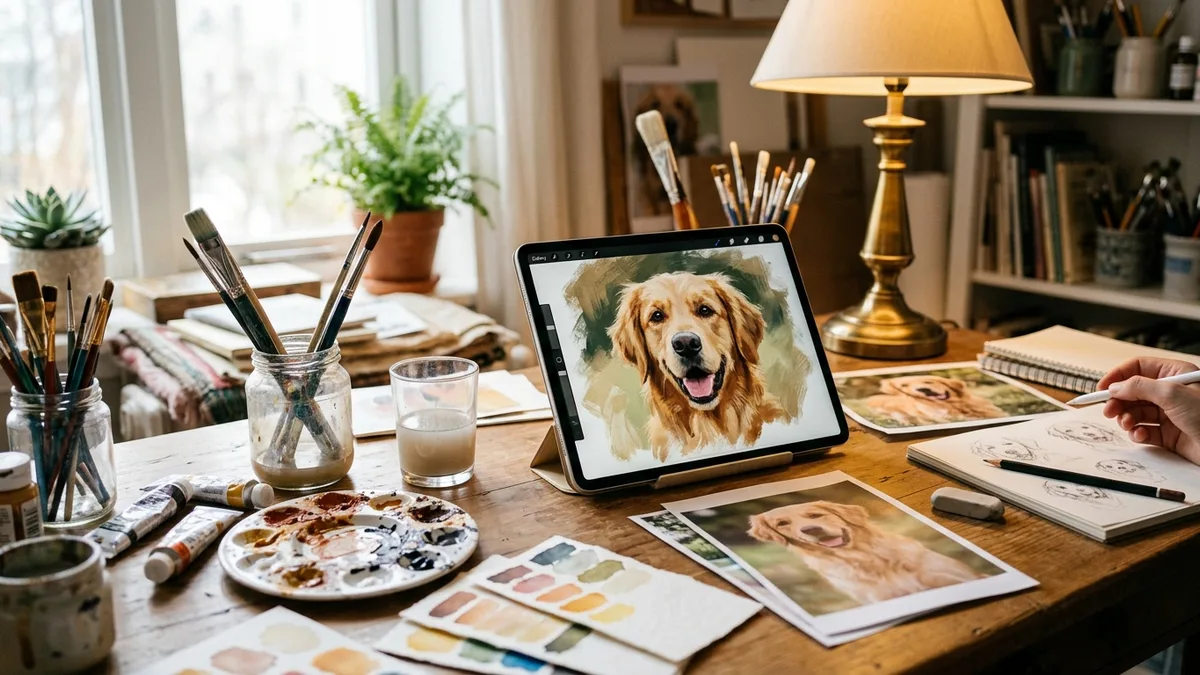
How AI Pet Portraits Capture Your Pet's Exact Markings
Every dog and cat carries a completely personal map of color. The liver spot tucked behind a beagle's left ear. The asymmetrical blaze on a tabby's forehead. The way a golden retriever's fur transitions from deep amber at the saddle to almost cream at the chest. These markings are how you recognize your pet across a dark room at midnight, how you would pick them out of a whole shelter full of similar animals.
A generic pet portrait — the kind that layers a stock style over a rough silhouette — misses all of that. You end up with something that looks like a golden retriever, not your golden retriever. That distinction is exactly what the MaginePaw process is built around.
What the AI actually looks at
When you upload a photo, the system does not just read "dog, golden, male." It builds a point-by-point map of your specific pet: the distribution of color across the coat, the exact placement of any patches or spots, the gradient where one tone fades into another, the texture differences between a soft belly and a denser back, the particular shape of face markings.
For cats, this means capturing things like a tortoiseshell's chaotic patchwork, the dark eyeliner stripes on a tabby, or the single white toe that sets one tuxedo cat apart from every other tuxedo cat on the internet. For dogs, it means reading the saddle on a German shepherd correctly, getting the brindle pattern to run in the right direction on a boxer, noting which ear is darker on a beagle.
The system pays attention to edges too — whether a color boundary is sharp or blended, whether a white patch has clean edges or feathers into the surrounding fur. These edge qualities are part of what makes a portrait feel specific rather than generic.
The six-take painting process
MaginePaw does not generate a single image and call it done. Each portrait goes through six painting passes, and between them runs an automated likeness review that compares each pass against your original photo.
The review checks a specific list of things: overall color distribution, the placement of key markings, face structure, the general tone of the coat. If a pass drifts — if the spot that should be over the left eye migrates to center, or if a merle pattern gets muddier than your photo shows — the system flags it and the next pass corrects back toward your photo.
Six passes sounds like a lot, but it is what allows the portrait to develop depth and texture without losing accuracy. The early passes lay down the broad strokes of your pet's coloring. The middle passes refine the markings and their placement. The final passes add the painterly detail — the way light catches fur, the softness of a whisker line — without overwriting what has already been established. By the time you see the finished portrait, the likeness has been reviewed and corrected at every stage, not just at the end.
Why markings matter more than you think
You already know your pet's markings. You see them every day. That familiarity is exactly why a portrait gets judged so sharply when something is wrong.
If a painter puts a spot in the wrong place, your eye catches it immediately even if you cannot articulate why something feels off. It is the same instinct that makes you notice when someone's hairline is slightly wrong in a caricature. The face reads as similar but not them.
Getting the markings right is what takes a portrait from decorative to personal. It is the difference between art that goes on a wall because it looks nice and art that makes you stop every time you walk past it. A portrait of your specific dog — the one with the half-brown, half-pink nose and the cowlick on top of his head — does something different than a portrait of a generic dog in a nice style.
That specificity is also why the different artistic styles available at /styles do not erase your pet's identity. A portrait of your cat in a Renaissance oil painting style should still be your cat in a Renaissance oil painting style. Style changes how the portrait looks. It should not change which pet is in it.
When the likeness review catches a drift
The automated review is most useful in cases where artistic style and marking accuracy start to pull against each other. Some styles have very strong visual languages — bold outlines, flat color areas, heavy contrast — that can work against the soft gradients of a merle coat or the fine stippling of a roan. Without a correction step, the style wins and the markings lose.
The review creates a tension between style fidelity and likeness fidelity and resolves it in favor of the pet. Style adapts. Markings stay.
There are cases where the review genuinely cannot fully resolve the tension — usually with photos that are underlit, taken at unusual angles, or heavily cropped. In those cases, the portrait is still generated and reviewed, but finer markings may be less precise. That is part of why the free repaint guarantee exists. If the final portrait misses something important — a particular eye patch, a split-color nose — you can request a repaint.
Getting the most out of your photo
The quality of marking capture depends heavily on the photo you submit. A few things make a real difference.
Natural light is better than flash. Flash flattens coat color and creates harsh shadows that obscure the texture and distribution of markings. A photo taken near a window on a cloudy day shows the fur's actual color far more accurately than a well-lit indoor flash photo.
Full-body shots help with coat patterns. If your dog has a distinctive saddle or your cat has a specific belly marking you want captured, a photo that shows the whole animal gives the system more to work with than a tight face crop.
Sharp focus matters most for face markings. If the face is slightly blurry but the body is sharp, the system can still read the body well, but may miss subtle facial details — a faint stripe between the eyes, the precise shape of a dark muzzle.
You can upload multiple reference photos. If one photo shows your pet's face perfectly but another captures the coat color better, submitting both gives the system a more complete picture to work from.
Before you commit to an order, the free watermarked preview lets you check the likeness on your own screen, in your own time. Compare it against your reference photo and see for yourself whether the key markings came through. If something is off, you can flag it before any printing happens.
The markings are the portrait
Technical accuracy in a painted portrait can sound like a cold thing to optimize for. But with pets, it is not. Your cat's inverted-V tabby stripes or your dog's liver-and-white speckle pattern are part of who they are to you. A portrait that gets those right is not just accurate — it is actually of your pet, not a stand-in for them.
That is what the six-pass process, the likeness review, and the focus on marking accuracy are all working toward. Not perfection for its own sake. Just a portrait that, when you hang it up, makes people say: that is definitely him.