


How to Photograph a Border Collie for a Custom Portrait
Border collies are fast, smart, and very camera-aware. Here's how to catch that legendary gaze on camera and get it right for a custom portrait.
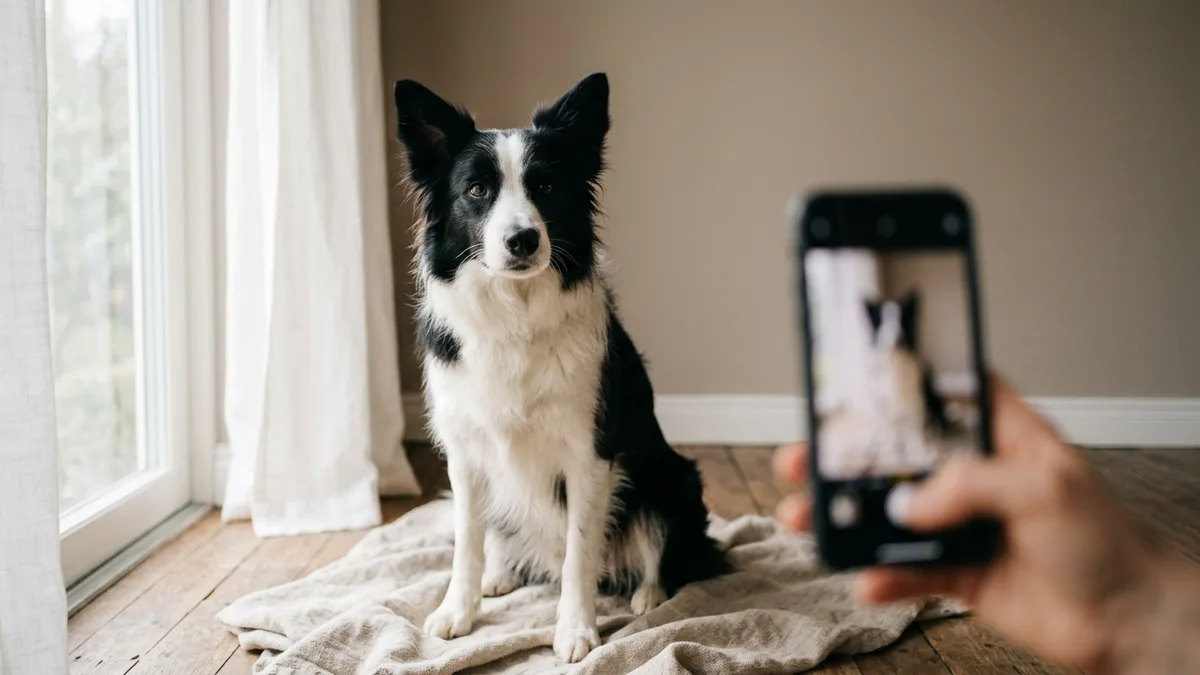
How to Photograph a Border Collie for a Custom Portrait
Border collies are, by most measures, the most intelligent dogs on the planet. They read your movements before you make them, anticipate the next command before you give it, and notice the exact moment you point a camera at them. Getting a genuinely good portrait photo of one takes more planning than it does with most dogs.
The good news: they are also one of the most expressive breeds there is. That legendary "eye," the intense, almost hypnotic stare they were bred to use when controlling livestock, is exactly what makes a border collie portrait so compelling. When a portrait captures it, you can feel it. When it doesn't, the painting looks like any other dog.
This guide covers what to think about before you shoot, what to look for in the finished frame, and what to avoid so your artist has the best possible starting point.
Understand what makes a border collie portrait work
Most border collies are black and white, which creates a specific photographic challenge: contrast. A bright white blaze against jet-black fur is beautiful in person but a headache for your camera's auto-exposure. Shoot in soft, even light rather than direct sunlight streaming through a window, which blows out the white areas while losing all detail in the black. Overcast days outside work excellently because the sky acts like a giant diffuser and renders both tones accurately.
If your collie is merle, tri-color, or sable, you have a bit more flexibility with lighting, but the same principle holds: avoid harsh shadows cutting across the face.
For the artists at MaginePaw, the face and especially the eyes are where a painting comes to life. A photo where the eyes are sharp and well-lit gives them far more to work with than a technically decent photo where the eyes are in shadow or slightly motion-blurred. The eyes are not a detail. They are the portrait.
Eye contact and sharpness
Border collies are intense lookers, but getting them to direct that gaze at your camera lens specifically takes a bit of staging. Hold a treat or a squeaky toy right above or just behind the lens. The moment they fix on it, take the shot. You want both eyes visible and in focus. Side profiles can be beautiful, but a three-quarter or straight-on angle gives the portrait painter the most information about what your dog actually looks like.
Autofocus on modern phones is generally reliable, but it can struggle with dark fur. If your collie is mostly black, tap the eye on your screen before shooting to lock focus there. Take a burst of five or six frames rather than a single shot. Even a settled dog will have one frame where the eyes are sharper than the rest.
Shoot at the dog's eye level or slightly below. Photographing down from a standing position makes any dog look smaller and slightly distorted. Crouch, kneel, or get on the floor if you have to. You want to meet them where they are, not loom over them.
Getting a working dog to slow down
Border collies were bred to move, think, and work. If you try to photograph one when they're in full "let's do something" mode, you'll get a gallery of blur and alertly-pointed ears aimed at something off-frame. Unlike some breeds that will hold a relaxed sit for thirty seconds while you figure out your camera settings, a border collie is constantly asking what comes next.
Time your session strategically. Right after a long run or a solid game of fetch is ideal. The dog is physically satisfied and far more likely to settle. Early morning before their first exercise of the day is usually not the right moment.
Indoors works well for border collies who are settled in their home environment. Let them find their natural resting spot, a favorite couch cushion, their bed, or a patch of floor they gravitate toward, and shoot from there. These natural, relaxed positions often make for the most compelling portraits because the dog's actual personality shows through rather than a performative sit-stay posture.
Some border collies respond much better to verbal cues than to food during a photo session. If your dog is highly food-motivated, a treat held behind the lens is ideal. If they're more toy-driven, a squeaky toy works. If they tend to get over-excited by either, try simply waiting them out. Settle on the floor nearby with your phone in hand and let them come down on their own. When they finally rest their chin on their paws and sigh, that's your moment.
That said, if your collie has an expression they make while working — mid-catch, locked onto a frisbee, zeroing in on a ball — those photos can be spectacular. Use burst mode and sort through afterward. You'll recognize the right frame when you see it.
What to send and what to avoid
A simple, uncluttered background works best. A plain wall, a clear stretch of grass, or a wooden floor lets the artist focus entirely on the dog. For black-and-white border collies, a mid-tone background in tan, green, or grey separates the coat cleanly. Pure white walls can merge with white fur; very dark backgrounds can swallow black fur. Neither is a dealbreaker, but neutral mid-tones give you the cleanest starting point.
Avoid photos where a leash is visible, where hands appear at the edge of the frame, or where another pet is partially in shot. Those elements pull the composition in directions that don't serve the portrait.
If you're ordering from /breeds/dog/border-collie, it helps to have two or three photos rather than just one: one showing the full coat pattern, one showing the eye color clearly (border collies can have brown, blue, or one of each), and one that captures the expression you'd describe if someone asked what they look like when they're just being themselves.
A few technical notes
File size matters. The larger the original image, the more detail the artist can extract. If your phone gives you the option to shoot in full resolution, use it. Do not submit a screenshot, a heavily cropped thumbnail, or an image downloaded from your own social media post. Social platforms compress photos significantly, sometimes reducing a high-resolution shot to something that barely holds up at small print sizes. Go back to the original file in your camera roll.
Avoid photos taken under yellow incandescent light, which casts a warm tone over black fur and makes it read as brownish rather than true black. Natural light or white LED light is far more accurate.
If you've run the photo through a filter app or boosted the saturation heavily, the artist is working from your processed version rather than the actual coat color. A lightly edited or unedited original is almost always better.
If your collie has heterochromia, one blue eye and one brown eye, mention it in the order notes. It's much easier to flag upfront than to request a revision after the portrait is finished.
Shoot in portrait orientation (vertical) for a headshot, or go wider if you want a full-body pose that shows the markings along their back and sides. Both work well. The choice depends on what you want the painting to emphasize.
The portrait starts with the photo
Every portrait MaginePaw paints goes through six separate takes and an automated likeness review before anything is delivered. That process works best when the source material is sharp, well-lit, and shows the dog's eyes clearly. A good photo doesn't need to be taken by a professional. Most phone cameras in decent natural light will do exactly what's needed.
Once you've chosen a photo you feel good about, the free watermarked preview is a useful test run. You can see how the image translates into your chosen style before you commit. If the eyes look flat or the coat detail is muddy, that's the moment to try a better-lit or sharper source photo. It's much easier to sort out at that stage than after the portrait is complete.
Take your time. Get down to their level. Wait for the real expression, not the camera-aware look they put on when they know you're watching. Border collies have something genuinely going on behind their eyes. A portrait is the chance to make that permanent.