


Renaissance Portraits of Golden Retrievers: Why It Works
Golden retrievers and Renaissance oil painting share more than you'd think. Here's why the style captures their personality better than any photo.
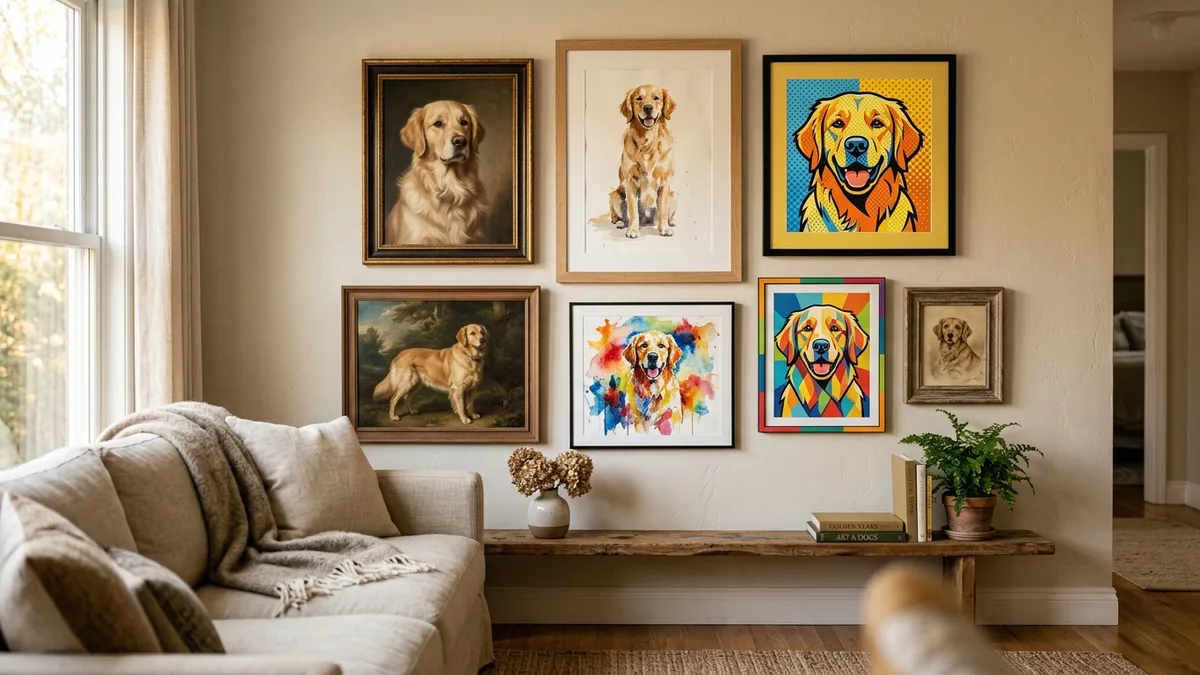
Renaissance Portraits of Golden Retrievers: Why It Works
There's a painting that keeps appearing on people's mantels and holiday cards: a golden retriever seated like a Flemish noble, draped in velvet, holding a goblet it definitely cannot use. People laugh when they first see it. Then they order one for their own dog.
The joke works. But underneath the humor is something that actually holds up visually, because the Renaissance portrait style and the golden retriever are, quietly, a near-perfect match.
Why golden retrievers specifically
Golden retrievers have faces built for portraiture. They have what painters call "presence" — a forward-facing gaze, wide-set eyes, and a mouth that naturally curves upward at the corners. In a photo, this reads as friendly. In an oil-painting treatment with the warm amber tones and raking light of a Renaissance composition, it reads as dignified. Wise, even. Like this dog has opinions about 16th-century trade policy.
Their coat helps enormously. Renaissance masters spent extraordinary effort painting fabric, fur, and hair because those textures caught light in ways that showed off their skill. A golden's coat — dense, layered, that particular warm blonde that shifts between honey and rust depending on the light — does exactly what velvet and damask do in a Holbein. It gives the portrait visual weight and warmth in equal measure. A short-haired breed in the same composition can look slightly flat. The golden fills the frame.
The color palette is practically made for them
Classic Renaissance portraits run on ochres, burnt siennas, deep crimson, forest green, and near-black shadows. Pull up a Jan van Eyck or a Titian and look at the tones. Then look at a golden retriever sitting in afternoon sun. The dog's coat already belongs in that palette. You don't need to work around the subject the way you might with, say, a white cat or a merle coat. The golden slides in as if it was always supposed to be there.
This is one of the reasons the Renaissance style, among all the options at /styles, tends to produce portraits that feel genuinely artistic rather than novelty-adjacent. The breed's coloring does real compositional work.
The personality fit matters too
A Rottweiler in Renaissance clothing is funny specifically because of the gap — powerful, imposing dog, absurdly formal setting. That contrast is the point. A golden retriever in the same painting lands differently because golden retrievers actually do behave like minor nobility. They greet guests at the door. They're offended by being left out of dinner. They have routines and preferences and a quality that their owners frequently describe as "judging me."
That air of gentle self-importance translates directly into the Renaissance pose: slightly turned, gaze directed at you with calm authority, one paw resting on something it owns. The golden wasn't forced into the role. It assumed it.
This comes up constantly in the portraits we make for goldens at /breeds/dog/golden-retriever. Owners describe their dog as "absolutely the type" or "she would have been a duke if she were human." They're not projecting onto the format. The format is showing them something they already knew about their dog.
What makes the painting technique work
Renaissance portraiture has specific techniques that serve dogs well. The background is typically dark and relatively simple — rich but uncluttered — which means the subject reads clearly. There's no busy background competing with the face. The lighting is directional and warm, which defines the shape of the head and makes fur glow rather than flatten.
The approach in MaginePaw's Renaissance style follows these same principles. Each portrait goes through six takes with an automated likeness review, comparing the result against your dog's actual face — the eye spacing, the ear set, the shape of the muzzle. The goal isn't a generic golden retriever in a collar and cape. It's your dog, recognizable, looking like themselves, placed into a painted context that elevates what's already there.
For goldens, the likeness process tends to be particularly satisfying because their faces are so expressive and specific. Two goldens can look very different from each other — different head shapes, different ear length, different eye darkness. Capturing those specifics is what makes the portrait feel real rather than decorative.
How to get a good source photo
The Renaissance style works best with photos where your dog is looking at you, lit from one side rather than straight-on flash, and relatively still. Phone portraits taken in natural light near a window are often ideal — the directional light already echoes what the painting style will do with shadows and highlights.
Avoid photos taken from above (they foreshorten the face) or in low light with a bright background (blows out the facial detail the portrait needs). You want to see the eyes clearly. Everything else follows from there.
If you're not sure whether your photo will work well, the free preview lets you see a watermarked version before you commit to anything. For a style as specific as Renaissance, it's worth checking the preview and seeing if the likeness lands before ordering prints.
Why people keep buying this for goldens
The Renaissance portrait has become the genre's defining combination because it satisfies two different audiences simultaneously. People who love fine art see a composition that actually holds up — the color, the light, the craft. People who love their dog see their specific animal honored in a way that matches their personality.
For golden retriever owners, there's an additional layer. Goldens are famously good-natured and famously beloved, but they also have a quiet intensity that photos don't always capture. A photo at the park shows the dog being a dog — happy, active, ears flying. The portrait shows something else: the self-possessed version, the one who sits at your feet in the evening and watches you with that particular golden retriever calm.
That's the version the Renaissance format makes visible. Not a costume. A portrait.