


Pet Portrait Size Guide: Matching Wall to Print Size
A practical guide to picking the right pet portrait size for your wall, from small hallway prints to gallery-worthy canvas pieces.
Pet Portrait Size Guide: Matching Wall to Print Size
Picking a size for your pet's portrait feels like it should be simple, but standing in front of a blank wall with a tape measure in hand, most people freeze. Too small and the portrait disappears into the wall. Too big and it feels like your dog is judging you from across the room every time you walk by. Here's how to actually figure out what fits.
Start with the wall, not the portrait
Before you even think about frame styles or canvas versus print, measure the actual wall space you have in mind. A good rule of thumb from interior designers is that art should take up roughly 60 to 75 percent of the width of the furniture or wall segment it hangs above. So if you've got a console table that's 40 inches wide, you're looking at a portrait somewhere between 24 and 30 inches wide, not a tiny 8x10 that gets swallowed up.
For empty wall space with no furniture reference, stand about 8 to 10 feet back and see what size feels balanced at eye level. Most people underestimate how large art needs to be to hold its own on an open wall.
Small sizes for personal spaces
Anything in the 8x10 to 11x14 range works best in spots where you're standing close: a bedside table, a bookshelf, a bathroom vanity, or a small gallery cluster on a hallway wall. These sizes are also great as gifts, especially if the recipient is still deciding where it'll live. Our $29 digital portrait option is perfect here too, since a lot of people print small sizes at home or through a local shop and only upgrade to our framed prints later once they've settled on the wall.
Small doesn't mean less detail, by the way. Every portrait, no matter the size you order it printed at, goes through the same six painting passes and an automated likeness check before it ships, so the whiskers and eye color come through just as sharp at 8x10 as they do at 24x36.
Medium sizes for everyday rooms
The 16x20 to 18x24 range is the sweet spot for most living rooms, home offices, and dining areas. It's large enough to be a real focal point above a sofa or a sideboard but doesn't require you to rearrange furniture to make room for it. If you're hanging a single portrait as the anchor piece of a room, this is usually where people land.
This size also plays well with our canvas and framed print options, which run from $39 to $219 depending on material and framing. A framed 16x20 tends to feel a step more finished than an unframed canvas of the same size, if you're going for a more traditional look in a living room.
Large sizes for statement walls
Anything 24x36 and up is a commitment, but it's the right call for a stairwell, an entryway, a large blank wall behind a bed, or any space where you want the portrait to be the first thing people notice when they walk in. These sizes work especially well for multi-pet households, since a bigger canvas gives each animal room to be seen clearly rather than cramming two portraits into a size meant for one.
If you're framing a large print, go a little heavier on the frame width than you would for a small print. A thin half-inch frame that looks great on an 11x14 can look flimsy and undersized once you scale it up to 30x40.
Matching print size to the portrait style
Not every one of our 12 signature styles looks its best at every size. Styles with fine detail work, like our pencil-sketch or watercolor looks, tend to shine at smaller to medium sizes where you can appreciate the linework up close. Bolder styles with strong color blocking or painterly texture, similar to what you'd see in our pop-art or oil-painting options, actually hold up better at larger sizes because the composition was built to read well from a distance.
If you're torn between styles and sizes, browse /styles before you commit. Seeing the same photo rendered in a few different treatments makes it a lot easier to picture how it'll look scaled up on a big canvas versus tucked into a small frame on a shelf.
Gallery walls and multiple portraits
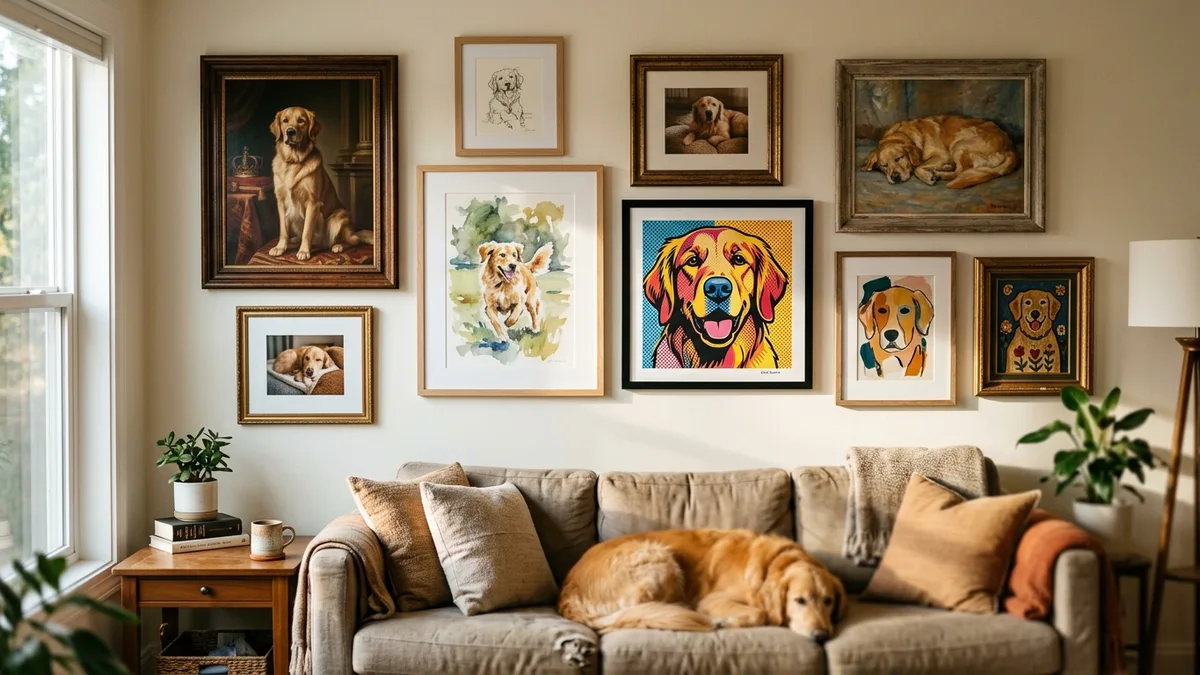
If you're building a gallery wall with more than one pet or mixing a portrait in with family photos, resist the urge to make everything the same size. A common layout that works well is one larger anchor piece (16x20 or bigger) with two or three smaller supporting pieces around it, spaced two to three inches apart. This creates visual hierarchy instead of a flat grid where nothing stands out.
For gallery walls specifically, it also helps to keep frame color consistent even if sizes vary. A mismatched jumble of gold, black, and white frames tends to look cluttered rather than curated, no matter how good the individual portraits are.
A quick way to test before you commit
Here's a trick that saves a lot of guesswork: cut a piece of cardboard or paper to the exact dimensions you're considering and tape it to the wall for a day or two. Walk past it at different times, in different lighting, and see how it actually feels in the space rather than just how it looks in your head. This is a five-minute exercise that prevents a lot of return shipping later.
It's also worth remembering that every order starts with a free, watermarked preview of the actual portrait before you pay for a printed version. That means you're not sizing a print based on guesswork about how the final image will look. You can see the real composition, check how much of the frame your pet's face and body fill, and get a sense of whether a tighter crop or fuller shot fits your wall space better, before any money changes hands on the physical print.
When in doubt, size up slightly
If you're stuck between two sizes, most people who've hung art for a while will tell you to size up rather than down. A slightly-too-large portrait reads as an intentional design choice. A slightly-too-small one reads as an afterthought, even if the artwork itself is beautiful. This is especially true for portraits of dogs or cats with a lot of personality in their expression, like the kind of soulful look you'd get in a Golden Retriever, if you want a closer look at how that breed tends to photograph and paint, our /breeds/dog/golden-retriever page has some good before-and-after examples of crop and sizing choices that work well for that particular face shape.
At the end of the day, the right size is the one that makes you stop and smile every time you walk past it, not the one that technically fits some formula. But starting with your actual wall measurements, rather than guessing, saves you from ordering twice.