


Bengal Cat Memorial Ideas: Gentle Ways to Honor Them
Bengals leave an outsized absence. Here are thoughtful, specific ways to honor your cat's wild spirit and singular personality.
Bengal Cat Memorial Ideas: Gentle Ways to Honor Them
Bengal cats are not subtle about anything. They announce themselves when they walk into a room, claim every surface as their personal territory, and somehow make you feel like the lucky one for being allowed to share your home with them. They chirp at birds through the window with an intensity that suggests they've developed a real strategy. They figure out how to open cabinet doors. They decide what time you should wake up in the morning, and their reasoning — while opaque — feels completely airtight to them.
When that presence goes quiet, the house can feel genuinely strange. Too still, too orderly, missing that specific unmistakable energy. A Bengal-shaped absence is larger than most.
Grieving them is its own experience, because Bengals are their own experience. These aren't one-size-fits-all cats, and there are no one-size-fits-all ways to remember them. Here are some concrete, gentle options.
Write down what made them unique
Before you settle on any specific memorial, spend a little time writing down the details that made your cat singular. Not "playful" or "affectionate" — every pet owner says those things. The specific stuff: the exact sound of their water fountain chirp. The particular game they invented that no other cat would have thought of. The way they draped themselves over the back of the couch like a very small, very opinionated leopard. The look they gave you when you sat in their spot.
These details are surprisingly easy to lose once grief softens the sharp edges of memory. Even one page of notes, written while everything is still vivid, will mean something later. If there are other people who loved your cat — family members, a roommate, a friend who cat-sat — asking each of them for one specific memory is a gentle way to start talking and to save things from different angles.
A portrait that honors their coat
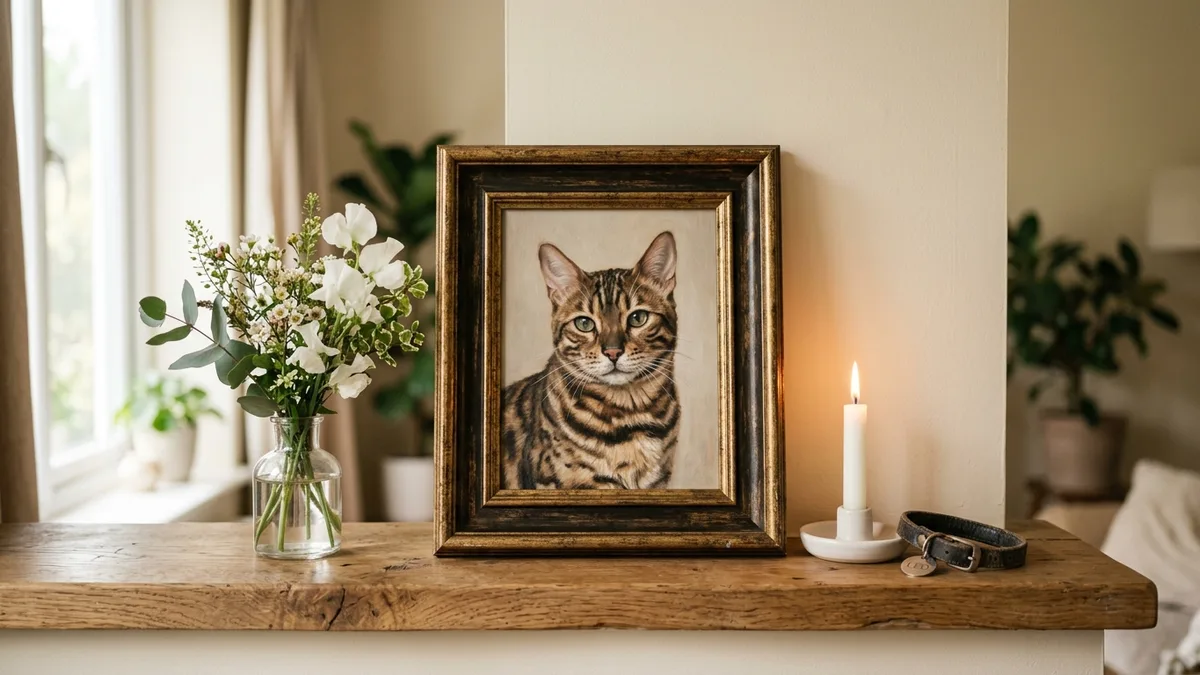
Bengal cats have some of the most distinctive markings in the domestic cat world — rosettes, marbling, that metallic glitter that shows up in certain lights, spotted patterns that look like something that belongs in a rainforest. A painted portrait is one of the few memorials that can actually honor that specificity, rather than reducing your cat to a generic stand-in for "cat."
At maginepaw.com/breeds/cat/bengal you can see how different portrait styles translate to Bengal coats. A few tend to suit them especially well. The Nature Portrait places your cat in a botanical setting with depth and texture, giving the rosette pattern room to read clearly. The Royal Portrait offers strong contrast and rich color that picks up the spots without washing them out. The Watercolor Classic is a particularly good fit for silver and snow Bengals, where the soft medium complements the luminous coat.
Every portrait goes through six rounds of automated likeness review before a human artist makes final adjustments, so the markings that made your cat yours actually show up correctly in the finished piece — the spot placement, the face shape, the eye color. If you're not sure which style feels right yet, you can request a free watermarked preview before you commit to anything. Framed prints start at $119 and are designed to live on a wall, not be tucked away in a box.
Make a real memory book
Not a folder of phone photos — a printed book with actual pages you can turn.
A Bengal memory book works especially well as a chapter-by-chapter project, because these cats tend to collect experiences. The kitten photos if you have them. The furniture they claimed. The catio or outdoor enclosure if they had one. The elaborate cat-proofing projects you eventually abandoned. The couch naps, the window vigils, the chaos. Bengals are naturally photogenic — they hold poses and tend to look directly at the camera with that particular bright-eyed alertness — so you likely have more good material than you realize.
Include a page of written memories for the things a photo can't capture: the sound of them, the warmth of them, the specific daily routines they imposed on you. A print-on-demand service can produce a 25 to 30 page photo book for $25 to $50. It doesn't have to be elaborate to be the right thing.
A donation connected to their lineage
Bengals were developed through crosses with the Asian Leopard Cat, a small wild species that still faces real pressure from habitat loss and the illegal exotic pet trade. A memorial donation to a wild cat conservation organization in your Bengal's name carries a specific kind of meaning that a generic tribute doesn't — it connects their memory to the lineage they actually came from.
Panthera, the Wildcat Sanctuary, and Big Cat Rescue all accept memorial gifts, and some will send an acknowledgment letter you can share with others who loved your cat. If you want something more local, look for small rescues in your area that work with wild cats or exotic species — they're often the most underfunded. It's a way of saying: what was wild about my cat came from somewhere real, and that place deserves to continue.
A garden space they would have claimed
If you have outdoor space — a yard corner, a balcony planter, a sunny windowsill box — a small garden can hold their memory in a living way. Catnip, catmint, silver vine, and valerian all attract cats to that spot over time. This might sound counterintuitive as a memorial, but it often feels right: life keeps returning there.
A flat stone with their name engraved, or a ceramic garden marker with a small photo pressed into it, can anchor the space without making it feel like a monument. The goal is a living corner, not a shrine.
What to do with their belongings
There's no correct timeline for any of this. Some people need to clear the food bowl the same day; others leave the water fountain running for weeks because the silence feels wrong without it. Both responses make sense.
When you are ready, unused food and sealed supplies can go to a local rescue or shelter — Bengal-specific rescues in particular are usually short on supplies and grateful for donations. Because Bengals have higher energy needs than many breeds, they have a higher rehoming rate too, which means those organizations are consistently stretched thin and genuinely appreciate help.
Keep one thing. The thing they loved most. The worn blanket, the particular toy, the cushion they shaped to themselves over years. You don't need to preserve everything, but that one item is worth holding onto.
Whatever you choose, make it as specific as they were. A Bengal's personality is too distinct to dissolve into a generic "beloved pet" memory. They were a particular, spectacular animal who had strong opinions about your schedule, your furniture arrangement, and the bird situation outside the window. The best way to remember them is to keep them exactly that specific.