


Pet Portraits for Your Office Desk: Small Prints That Fit
Your desk should feel like yours. Here's how to choose the right pet portrait size and style for a workspace that keeps you sane.
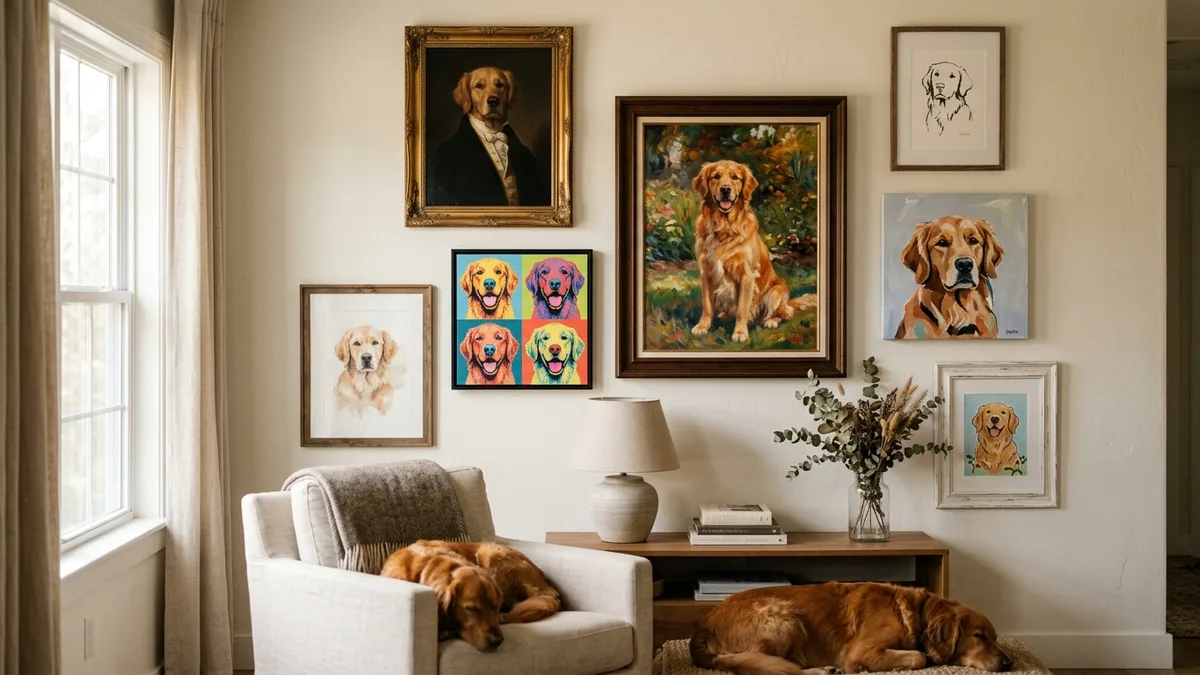
Why your desk needs a pet portrait
Most office desks have the same things on them: a laptop, a dead succulent, maybe a mug with a motivational phrase nobody asked for. Then someone walks by, spots a custom portrait of your basset hound rendered in a Renaissance oil painting style, and suddenly you're the most interesting person in the building.
There's a more grounded reason too. Personalizing your workspace, even in a small way, has a real effect on stress and focus. A photo of your pet does some of that work, but a painted portrait does it differently. It has an obvious craft to it. It signals that someone made something specific to this animal, and that animal matters to someone. Every time your eyes land on it between calls or meetings, you get a small, clean mental break.
For remote workers especially, the line between home and work is already blurry. A portrait of your dog or cat on the desk doesn't blur it further — it anchors you. It's a reminder of what's actually in the room with you while you type.
What size actually fits a workspace
The challenge with desk art isn't finding something you like. It's finding something that fits without eating into the space you need to function.
For most standard desks, the practical range is somewhere between 5×7 and 8×10 inches. Go smaller than 5×7 and a detailed portrait loses a lot of what makes it worth having — the texture, the brushwork, the way a well-painted portrait actually reads as the specific animal it depicts. Go larger than 8×10 and the piece starts competing with your monitor and anything else that needs to live within arm's reach.
An 8×10 framed print sits well at a desk corner or on a small tabletop easel. A 5×7 can lean against a monitor base, a bookshelf, or a stack of things you keep meaning to file. If you have a shelf directly at eye level above your desk, you have more flexibility — an 11×14 works well there, and you'll actually see it during the day.
If you're unsure about size before committing, the free watermarked preview is worth using. You'll see exactly how your pet's portrait looks — the composition, the level of detail, whether the likeness landed — before anything is ordered or printed. That makes it easier to judge whether you want a smaller digital file to print locally or a larger framed piece shipped to you.
Choosing the right style for an office setting
Not every portrait style reads the same way in a professional space. Some styles are bold and demand attention. Others fit quietly into a workspace without making anyone uncomfortable.
A few styles that tend to work well in office environments
The Watercolor style has a loose, painterly quality that reads as art even to people who don't follow portrait work. It's warm without being loud, and it holds up well at smaller sizes because the style's softness suits intimate formats.
The Pencil Sketch style is the one that looks like it belongs in an architect's studio or a design firm. Clean lines, no color, nothing that pulls focus. It's understated in the most useful way.
The Royal Oil Portrait style is for workplaces with some personality. Your cat in an Elizabethan collar. Your dog with a dignified gaze against a gold background. It's an obvious conversation piece, and it works especially well in creative fields where people expect a little irreverence.
The Minimalist Line Art style is exactly what the name suggests — a simple, elegant line drawing that suits any environment and pairs well with modern desk setups that are already pretty spare.
You can browse all twelve signature styles at /styles to see which direction fits your pet and your workspace. Some animals have a natural gravity that suits something formal. Some have a chaos energy that deserves a more expressive treatment.
Getting the photo right before you order
The portrait is only as good as the reference photos you start with. For a small desk print, this matters more than you'd think — a portrait painted from a blurry or backlit photo will look soft and vague at any size.
For best results: photograph your pet in natural light, facing toward the light source rather than away from it. Get close enough that their face fills most of the frame. Avoid flash, which tends to flatten features and produce that flat, reflective eye look. Take more photos than you think you need and pick the two or three where your pet's expression actually looks like them on a normal day — not panicked, not mid-sneeze, but present.
If your pet is hard to photograph because they never stop moving, try catching them right after a walk or a meal. A slightly drowsy animal is a cooperative one.
How to display a small print without adding clutter
A small print only works if it's displayed with some intention. Propped awkwardly against a cable, or half-hidden behind a water bottle, doesn't do the portrait or your desk any favors.
A tabletop easel is the cleanest solution. Small wooden or metal easels are inexpensive and let you angle the portrait at the right height so it's genuinely visible while you work. The portrait looks considered rather than dropped there.
A floating frame — where the print sits slightly in front of the backing — adds dimension to a small image and looks more intentional than a basic clip frame. These suit watercolor and sketch styles especially well, where the white border becomes part of the composition.
If you have a shelf directly in your sightline, leaning the framed portrait against the wall with a small object anchoring the front is a clean, low-effort approach that takes thirty seconds and doesn't require drilling anything.
One thing worth avoiding: placing the portrait somewhere you can only see it when you stand up. The whole point is to actually see it during the day.
The portrait as a conversation starter
Something happens when there's a genuinely good piece of art on a desk. People notice it. They ask about it. And then you get to talk about your dog or your cat, which is almost always a better conversation than the one you were about to have about project timelines.
This is more useful than it sounds. Work relationships get stronger through small personal moments. Knowing that your colleague has a three-legged rescue cat named Morley, or a golden retriever who ate an entire birthday cake last summer, is the kind of thing that makes a team feel like people instead of calendar invites.
A custom portrait invites that conversation more reliably than a photo does, because it has craft behind it. People respond to that. They ask how it was made, whether it really looks like the animal, what style it is. It gives them a specific, easy entry point into a real conversation.
Ordering for your desk or gifting one to someone who works
A desk portrait is a practical gift for anyone who spends most of their day at a computer, which is most people. It's personal, it fits in a bag, and it suits the actual daily life of the person you're giving it to.
Prints and posters start at $39, and shipping is free on orders over $75. If you'd rather give a digital file — useful if the recipient wants to print it at a specific size or use a local framer — that starts at $29.
Every portrait is painted in six passes with an automated likeness review built into the process, so the final result is checked against your pet's reference photos before it's delivered. If the likeness still isn't right, the free repaint guarantee means it gets redone until it is.
For anyone spending most of their working hours at a desk, a small portrait of the animal waiting at home is one of the lowest-effort, highest-return ways to make that space feel like it belongs to them.